What happens when you turn a political party into a personality cult? A midterm wipeout
GOP operatives are in denial.

Editor's note: Today's edition of the Editorial Board goes out to everyone. If you're not subscribing, consider doing so today. The newsletter is how I make a modest living. It's how I pay the rent! I can't do this alone. Please join us. Link at the bottom. Thanks! –JS
It's hard to believe, but apparently "the entire GOP political ecosystem" is now dedicated to the idea that what worked in 2024 is going to work in the coming congressional elections. Every level is focused on "building a turnout operation with the sole focus of identifying, engaging and ultimately persuading 'low propensity' voters," according to Alex Roarty.
In a story in NOTUS today, Roarty reported that operatives have been planning to run the same play "from almost the moment the 2024 campaign ended." By focusing on nonvoters – people "who maybe cast a ballot two years ago but often skip midterm elections" – the aim is "solving a traditional problem for parties in power during midterm elections when their voters become more complacent and turn out in lower numbers than their opposition’s."
Why is this hard to believe? First, because the fundamentals for 2026 are arguably the same as they were in 2024, but dramatically worse, in which public opinion turned sharply against the party in power due to inflation, prices, wages and the economy generally. The obvious difference is the party in power is not the one that Donald Trump and the Republicans ran against two years ago. A new poll puts his overall approval at 30 percent, with 82 percent saying that they expect conditions to get worse over the coming year. Importantly, people keep telling pollsters that they hold the president personally responsible for their misery.
 John Stoehr
But there's another reason the GOP's "plan to win" is hard to believe. It depends on a paradox. On the one hand, operatives believe that Trump supporters who usually vote are not going to show up. On the other hand, they believe Trump supporters who usually do not vote – "low propensity voters" – will show up to replace Trump voters who are not going to show up. In other words, "the entire GOP political ecosystem" believes that voters won't vote but nonvoters will. Everyone sees this house of cards but no one is ready to admit it. "We kind of compare notes on everything, making sure that we’re all seeing the world the same way. Which we do,” CLF’s Joe Pileggi told NOTUS. “There’s no fragmentation in our thinking.”
I guess unity is the play you make when you don't have a better play.
After all, Republican consultants gotta get paid, too.
It used to be that casual voters supported Democrats during presidential elections, then disappeared until the next one. That gave the GOP the advantage during midterms. Trump changed that. He chased away educated and mostly white middle- and upper-middle class voters, and replaced them with working-class voters who were more racially diverse but less prone to voting. Democrats have had the advantage since. Even the 2022 midterms, when Joe Biden was president, did not produce a red wave. The Republicans took the House but barely.
The economy was also in better shape back then. Last week, the Post released a review of 990 races, over three cycles, in 25 states. It found that "turnout is rising in Democratic primaries even when they aren’t hotly contested and the nominee has little chance of winning in the general election." The Post looked at all Democratic House primaries held this year and found that, in more than 90 percent of them, "voters cast more ballots than during 2022, when Republicans flipped the House. So far this year, people cast 12.6 million ballots in Democratic House primaries compared with 8.6 million in GOP primaries" (my italics).
 John Stoehr
Honestly, it smells like cope.
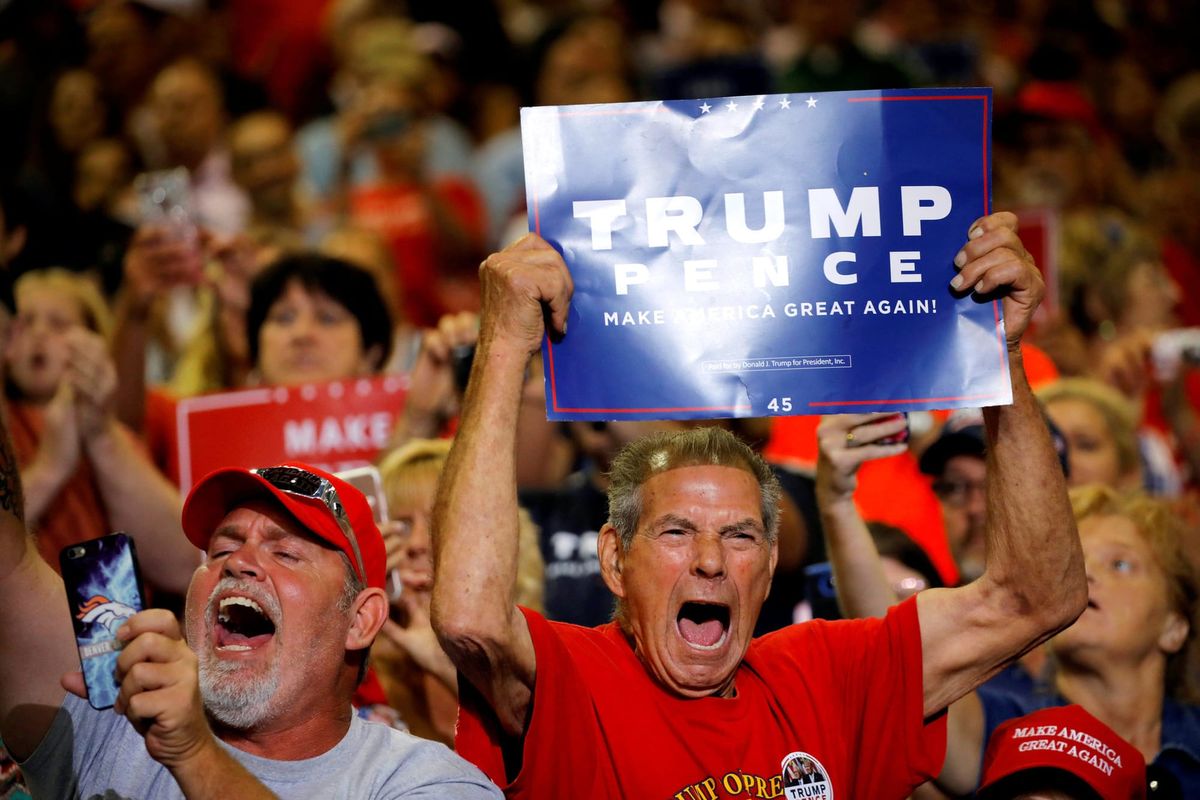
The GOP operatives are targeting people who are not going to show up for Republicans, because they hate Republicans. That's the point. Trump was the anti-party candidate "who hated politics," which is to say, who hated the parties as much as they did. These are not educated people. They do not understand, or care to understand, that parties are mechanisms by which power is organized for the purpose of enacting policy or maintaining advantage. They were drawn to Trump for a simple reason: They thought he was a successful businessman who would rise above the parties to do what needed to be done for them.
The GOP operatives who said they expect in 2026 the outcomes of 2024 are in denial. They're biggest problem is that Trump turned their party into a personality cult. They said "low propensity voters" didn't turn out for GOP candidates in 2018 because "the party was still struggling to embrace Trump’s leadership." Hardly. They didn't turn out because they weren't thinking about GOP candidates at all. Their loyalty was for him, not for them. From their view, they would still be loyal even if they decided this time to vote for a Democrat.
That's all for today. Please consider subscribing! I know you like it. I know you'll love the price! For just $9 a month, you get so much, plus the satisfaction of supporting independent journalism. (Don't know if you're a subscriber? Check your status below.) –JS