Jeffries understands the assignment. Does Schumer?
Schumer "makes me nervous by not showing his hand," Jill Lawrence told me.

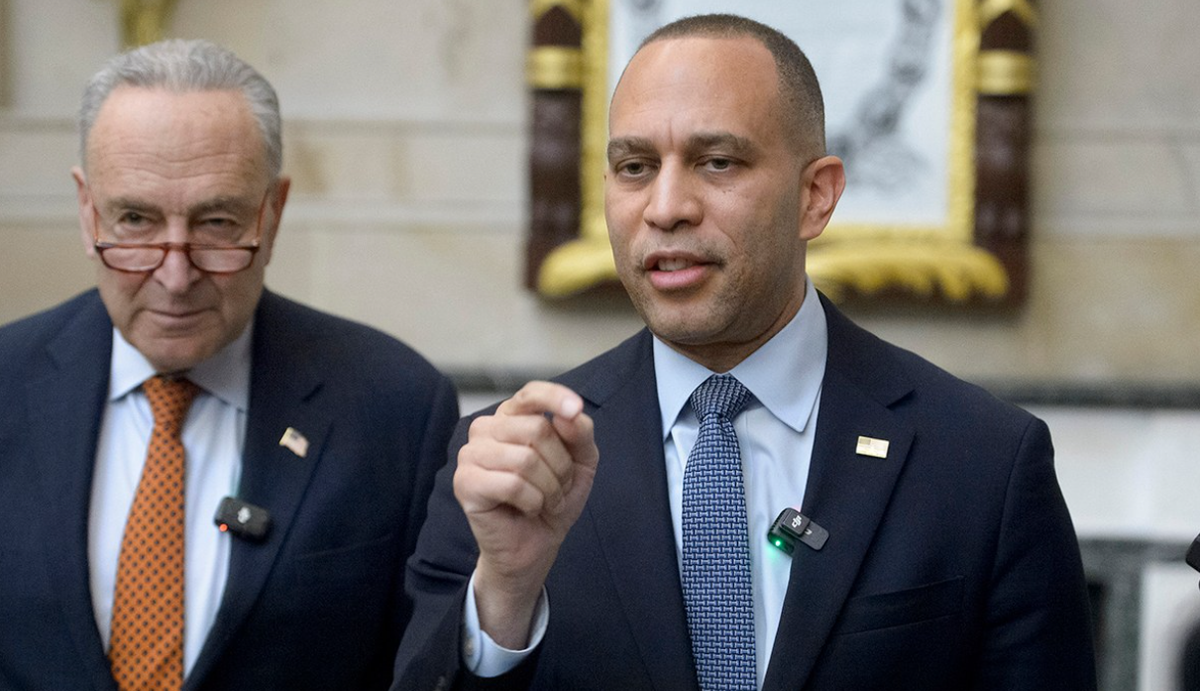
One of two questions about Democratic leadership in the next session of the United States Congress was answered today. The Democratic caucus nominated Hakeem Jeffries to be the next speaker of the House. Unopposed, Jeffries won by a vote of 251-11. Progressives, moderates, conservatives – they all wanted him. The Democrats are going to have a massive majority come January, meaning that Jeffries is all but certain to be the first Black speaker.
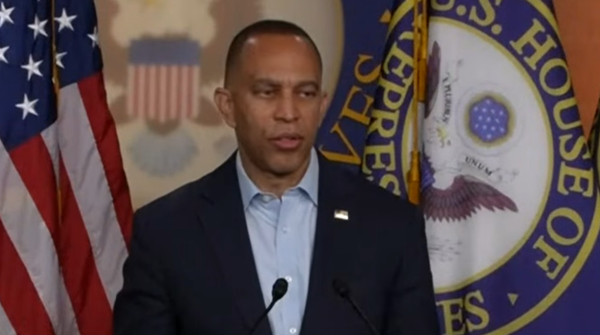
I’ve had my quibbles with him, but on the whole, Hakeem Jeffries seems to understand the assignment. During a presser Tuesday, he said that one of the priorities of his caucus is achieving “universal access to health care," among other affordability issues. In a presser last week, he said that “we’ve got to deal with accountability, because there’s a cost to corruption when you have people in government who are stealing from the American people.”
The Post reported that Jeffries didn’t take today's vote for granted. He met with every new Democrat and “the leadership of the Progressive, New Democrat and Blue Dog caucuses, which span the ideological spectrum of the broader Democratic caucus.” His surrogates “worked the phones to gauge members’ priorities and concerns — and limit defections.”
[Leave a tip in the tip jar! Say $10? THANKS!]
Seven Democrats who voted against him, all newly elected, wanted to see more on universal healthcare, campaign finance reform, ICE reform and ending funding for Israel’s war in Gaza. But they also saw a leader they can work with. In a statement, they said: “While we have seen meaningful progress, there is still work to be done to ensure that the direction our party takes this coming Congress reflects what our constituents are demanding of leadership.”
I have occasionally documented the evolution of Jeffries’ rhetoric to suggest that he can be moved with enough hell-raising and will adapt to shifting demands, hallmarks of good leadership in my opinion. Most recently, he called Stephen Miller, the architect of the president’s murderous deportation agenda, a “stone-cold racist.” To me, that indicates that the Democrats had fully learned that there’s no point in continuing to pretend that they can break the GOP’s authoritarian fever by upholding their end of a settlement, originating in the 1960s, that the Republicans stopped honoring after the election of the nation's first Black president. He said he would not meet with Miller, which suggests an understanding that if there’s going to be a bipartisan peace, it’s going to be through strength, not compromise.
Which brings me to the second question of Democratic leadership, namely Chuck Schumer. I just don’t know about him. It’s not that he can’t do the job. It’s not that he doesn’t deserve credit for his role in the midterms and the greatest rebuke of a sitting president in our lifetimes. (Schumer is partly or greatly responsible for flipping Senate seats in Kansas, Alaska, Iowa, North Carolina and Texas; do not let the antisemites tell you differently.) What concerns me is that he’s not hearing what Jeffries is hearing, and that he takes his job for granted. (He has been the Senate leader for 13 years.) That combo allows him to say bonkers things, like the midterms being a preface to a “durable majority” of 60 votes in 2028.
Democracy cannot survive if survival requires one party to win over and over. Survival requires serious institutional reforms that level the playing field and ensure fair procedures. Those reforms begin by eliminating the filibuster (the Senate rule requiring a 60-vote majority to pass legislation). Schumer has fought past efforts to nix the filibuster and apparently believes the Democrats don't have to revisit the issue if they can win elections over and over, and that’s just not realistic. We all remember 2024. Parties win. Parties lose. Someone has to light a fire under Schumer and that someone might be Chris Van Hollen.
For the first time in decades, a sitting Senate leader is facing a challenger. Van Hollen, a progressive who favors ending the filibuster among other institutional reforms, needs 28 votes to win. He has five, according to the Post. (They include Senators-elect Abdul El-Sayed and Peggy Flanagan.) Van Hollen says 10 more support him privately. The Post said four oppose Schumer, but haven't pledged to Van Hollen. Meanwhile, 16 Democrats support Schumer openly. With a vote set for December 1, the odds seem to be in Schumer's favor.
Even if Chuck Schumer wins, however, the filibuster might still be on borrowed time, wrote Jill Lawrence, a former opinion editor for USA Today and author of The Art of the Political Deal. In her newsletter, History Keeps Happening, she wrote that if Van Hollen wins, "that’s all to the good," but if he loses, perhaps "he extracts promises from Schumer to rethink a crippling custom that guarantees most Americans will rarely get what they voted for."
I wanted to dig a deeper with Jill about that point and others.
Here's our conversation.
John Stoehr: Van Hollen could win, but if he doesn't, will Schumer learn? Would he nix the filibuster as a consequence, as you suggest he should?
Jill Lawrence: Schumer did try at least once to waive the filibuster for a very important bill, a 2022 voting rights and access package supported by all 50 Democrats in the Senate. It would have passed with Vice President Kamala Harris breaking the tie, but at least two Senate Democrats refused to go that route and pass it without any Republican support. Those two – Senators Joe Manchin and Kyrsten Sinema – are gone now, and I would hope anyone still there who’d been clinging to the bygone ideal of bipartisanship-or-bust would be over that by now. That includes Schumer, who makes me nervous by not showing his hand. Van Hollen is much more straightforward about the anti-democratic nature of the filibuster and his view that it should go.
One theory is that this is not the end for Schumer but the beginning of the end, and that the party is greasing the skids for his departure from leadership after 2028. What's your view?
I do think it’s logical to expect him to retire after 2028, especially with AOC making it clear that she’s going to run for some higher office and meanwhile freezing her eggs because she wants to have a family. I’m sort of but not really joking. A six-year Senate term makes sense for her, and a 2028 exit makes sense for Schumer, who will be 76 next week. He can either serve the next two years as majority leader and try to prove he’s got what it takes to handle the unprecedented challenges we’re up against, or as an elder statesman/coach-player offering support and guidance to a successor.
How important is nixing the filibuster given that Trump is almost certainly going to veto anything the Dems get through the Congress?
To me it’s extremely important. Democrats keep falling short on their promises, and it’s often not for lack of trying. They should use the next two years to change that. One example is the DREAMers program that protects undocumented people brought here when they were kids. Trump blew up a deal in his first term (even after saying how much he loved the Dreamers), and when Democrats tried to cram it into a budget bill (“reconciliation”) that only requires 51 votes, the parliamentarian said no because it was not revenue-related. Who out in America is going to realize all that?
They should just get rid of the 60-vote impediment and pass exactly what they want to lower prices, clean up corruption, stop ICE abuses and the Iran war, reverse health care budget cuts, restore voting and abortion rights, raise the minimum wage, reform the Supreme Court and the pardon power – the works. Let Republicans vote no if they want to. It’ll be a platform for all Democrats in 2028, and if Trump by some chance signs a bill once in a while, it’ll be a win for American voters.
What is he talking about with "a durable majority" of 60 votes? Is he delusional or are we getting played by a headline about that?
“Flirting” with 60 seats and trying to win them is, of course, a great idea. But counting on a “durable” majority, either that size or the 56 seats Democrats will have next year, is a fantasy. It reminds me of the whole “demographic destiny” argument that Democrats once made when they counted on a growing minority population and their party winning a lion’s share of minority voters forever. It hasn’t worked out that way. These large majorities come and go, and rarely reach 60. Democrats supposedly had 60 votes in the 2009-2010 Senate, but it was a fragmented and fraught supermajority.
Al Franken of Minnesota – the 60th Democrat – wasn’t sworn in until July 2009 after a lengthy recount battle. Massachusetts Senator Edward Kennedy died on August 25 that same summer. A Democratic appointee, Paul Kirk, held the seat from September 25, 2009 to February 4, 2010, when Republican Scott Brown won a special election and was sworn in. And that was that.
Your thoughts on Schumer proved controversial. Why do you think that is?
Some people live by the mutually assured destruction doctrine. They want Democrats to hold back for fear of what will happen if Republicans decide to get rid of the filibuster. My theory is that the filibuster protects Republicans from unpopular bills they don’t want to pass, like the SAVE Act that would make it much harder for many people – including their own supporters – to vote. And if they did take power and pass their agenda, I truly doubt America would fall in love with it. Other people don’t see the point of passing things that Trump will veto.
But as I’ve said, I think it’s very useful as a high-profile way to showcase Democratic priorities and plans for 2029. Others fret that Trump will sign things and get credit for them. It’s hard for me to see him signing many Democratic or even bipartisan bills into law, given his hardline inner circle, the many Democratic-led investigations about to come down on him, and his history of refusing to negotiate if he’s mad about Democrats’ “phony investigations.” But if I’m wrong, well, Democrats can say they did stuff, he can say he signed it, and all the better for the republic, right?