Fight rightwing propaganda with antitrust law
The monopolists own the playing field. Break it up.

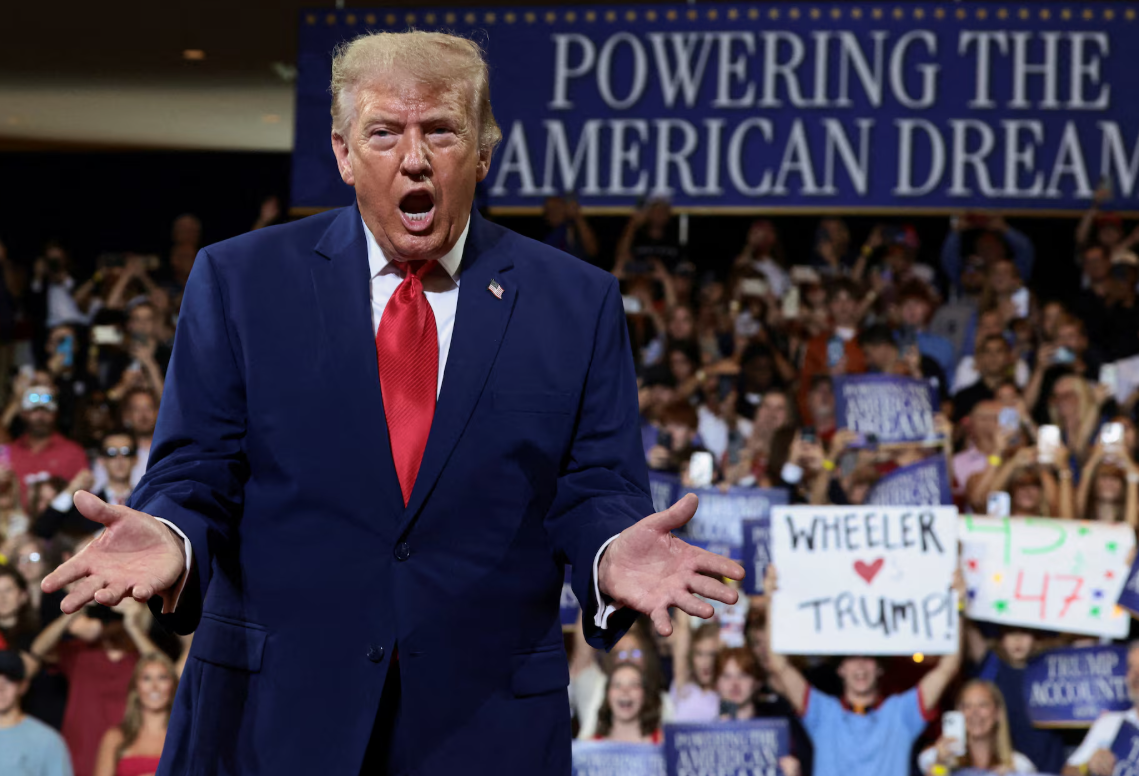
The president fell asleep again. He was listening to a speech by Xi Jinping, the head of the Chinese Communist Party. Seated, with hands clasped, Donald Trump’s eyes closed and stayed closed. The moment was played on a giant screen at the APEC summit’s media center. Reporters laughed. They took pictures. It was big news everywhere, except in America.
Via McGill Media.
Here it was just more of the same. Why?
The Bulwark's Sarah Longwell has a theory: “One weird trick that Trump and his inner circle have been able to pull off is taking a Democratic scandal — Hillary’s server, Hunter’s laptop, sleepy Joe — and committing the same offense — security lapses, monetizing access, literally falling asleep — by putting rocket fuel under them to achieve enormous scale. Somehow by being 1,000 times scale of magnitude worse than the Democratic scandal, they overwhelm the system. The scandals are too big for the discourse to really get its arms around.”
That’s not quite right, though. Fox and other cable networks, Twitter, Meta, TikTok – and increasingly CBS News, CNN and other legacy outlets – these are, in various ways, part of the rightwing media apparatus. Scandals involving Trump rarely break through, not because the discourse can’t get its arms around them, but because the discourse makes them so normal as to be invisible. Old age was a scandal for Joe Biden. It was existential crisis for his party.
For Trump, it’s Tuesday.
[Leave a tip in the tip jar! Say $10? THANKS!]
Our media environment is now so slanted to the right that Americans often know less about what the Democrats say than about what the Republicans say the Democrats say, a dynamic that greatly determined the outcome of the 2024 election. Acknowledging this reality, some on the left have overcome their natural disgust for propaganda in order to call for a left-coded media environment of their own. In response, the Democratic National Committee transformed a campaign effort into FactPostNews. In the run up to the 2026 midterms, FactPostNews accounts across social media dug up embarrassing and problematic video clips of Trump and the Republicans, presented them through a factual lens that nonetheless advanced the party line, and created a network of creators to disseminate them. As Denny Carter said today in Liberal Currents: “Everything was designed to make Democrats look good and Republicans look bad — you know, the very point of effective propaganda.”
This is a big step for the Democratic National Committee. In the past, it was fearful and controlling. It was scared of what free agents might do to the party’s message if given leeway. Most resources went into making TV ads that have increasingly limited effect. Indeed, that's still the case. But the DNC’s embrace of propaganda is a welcomed development – and overdue. Liberal democracy does not speak for itself nor does it tell its own stories. “People only understand the world through stories. So give them one: Democracy vs. autocracy, dignity vs. oppression, constitutional rule of law vs. totalitarian lawlessness, good vs. evil," Carter said. “These are stories, I think, that need to be told by whatever means necessary.”
That said, it’s not enough. The Democrats might get good at liberal psyops, which for the time being might help democracy more than harm it. But in the end, propaganda is still the GOP’s game, because the vehicle that carries all forms of propaganda – whether rightwing or liberal – is theirs. They spent 60 years building the rightwing media apparatus. They invested billions. They created a vast information and surveillance structure that is increasingly concentrated in the hands of a few, with the pace of concentration accelerating with the integration of artificial intelligence technology. The Republicans own home field. (They own all the fields!) The Democrats are visiting. If they hope to change the game, the Democrats must change the rules, and the way to do that is by enacting and enforcing anti-trust law.
Look at it this way. Before the 2024 election, the Joe Biden administration took aim at Apple in a lawsuit alleging abuse of its phone monopoly. That move came after lawsuits were filed against Amazon and Google, both alleging unfair market dominance. And those lawsuits followed a slew of executive orders by Biden that focused on anti-competitive practices across the economy. “Capitalism without competition isn't capitalism,” the former president frequently said. “It's exploitation.” As for AI, Biden was no fool. It showed great promise, he said. It could help cure cancer. But it also posed great peril to privacy, national security, free and fair elections, and the public trust. His ordered his administration to draw up and enforce rules to set limits on AI while harnessing its potential. From the monopolists' view, however, Biden was gearing up to control their ambitions and suppress their profits, and Kamala Harris would pick up where he left off. They reacted by lifting prior constraints on their platforms under the guise of protecting free speech. Barack Obama and Hillary Clinton faced their share of bile and hatred but that was nothing compared to what the vice president faced. "Such claims are now turbocharged, fueled by an increasingly aggressive tone of political speech endorsed by top politicians, powered by artificial intelligence and other new technologies, and let loose across a far more fragmented online landscape crowded with unmoderated platforms," the Times reported in July 2024.
The monopolists got what they wanted. Trump scrapped Biden's AI rules and allowed his antitrust agenda to stall out. He aligned himself with Silicon Valley to trigger a build out of AI infrastructure that has been so massive that it's currently floating an economy that is otherwise struggling to grow in the face of war-related inflation and high energy prices. (This week, Anthropic's IPO was the biggest in Wall Street history.) In two years, the data centers that power AI went from barely visible to extremely visible. The 2026 midterms were an across-the-board backlash against the monopolists nearly as much as they were against the president. (One advocacy called them "the first AI and tech accountability election.") If there’s any doubt, look at their behavior. Elon Musk, who spent half a billion dollars on Republican candidates, now says he was never maga. Alex Karp, the head of AI surveillance firm Palantir, now says he was always progressive. Sam Altman is talking up “human-first” messaging amid the data-center revolt. Ditto for Jeff Bezos. Experts expect him to hype “green energy” to divert attention from his data centers poisoning the environment. The CEOs of Apple and Google appear to have bribed the president into giving them tariff carveouts. They are expected to return to themes of privacy, diversity and not being evil. Nvidia is awash in scandal, as its former CEO seems to have colluded with the Chinese Communist Party to undermine US security. Expect to hear more about Nvidia’s progressive values. (As I was writing this, the Post reported that the Trump administration approved sales of Nvidia's AI chip technology to China in exchange for "for a cut of the revenue.")
The backpedaling suggests the monopolists are worried about the Democrats smashing their fiefdoms and draining their power. Congressman Jamie Raskin introduced in October the Antitrust Accountability and Transparency Act. The objective is “restoring the idea that antitrust enforcement must serve the people – not conglomerates and special interests with beltway lobbyists,” he said. Raskin will be House Judiciary chairman in January. Senator Chris Van Hollen, who is running for Senate majority leader, said a bipartisan antitrust bill that was tabled in 2022 would be “No 1” on his to-do list. Other congressional Democrats are preparing to flood the zone with AI-related legislation to protect consumers, lower prices and secure public trust. These are aspects of a broader trend that Chuck Babbage calls a “techlash.” “How do we tame the corporate monsters to the point where they can be held accountable for making these destructive products?” he wrote in Liberal Currents. “And here are two answers: by wielding the tools of product liability law and antitrust reform.”
The Democrats have no choice right now. They must play the propaganda game, according to rules already established. But propaganda is a means to an end, not the end itself, and that should come as a relief. Liberals prefer open combat between competing values, not covert ops through shadowy channels. By using the hammer and tongs of antitrust law and the regulatory state, the Democrats can change the game so no one solely owns the field.