Let gratitude be the start of justice, and justice the source of plenty, for all
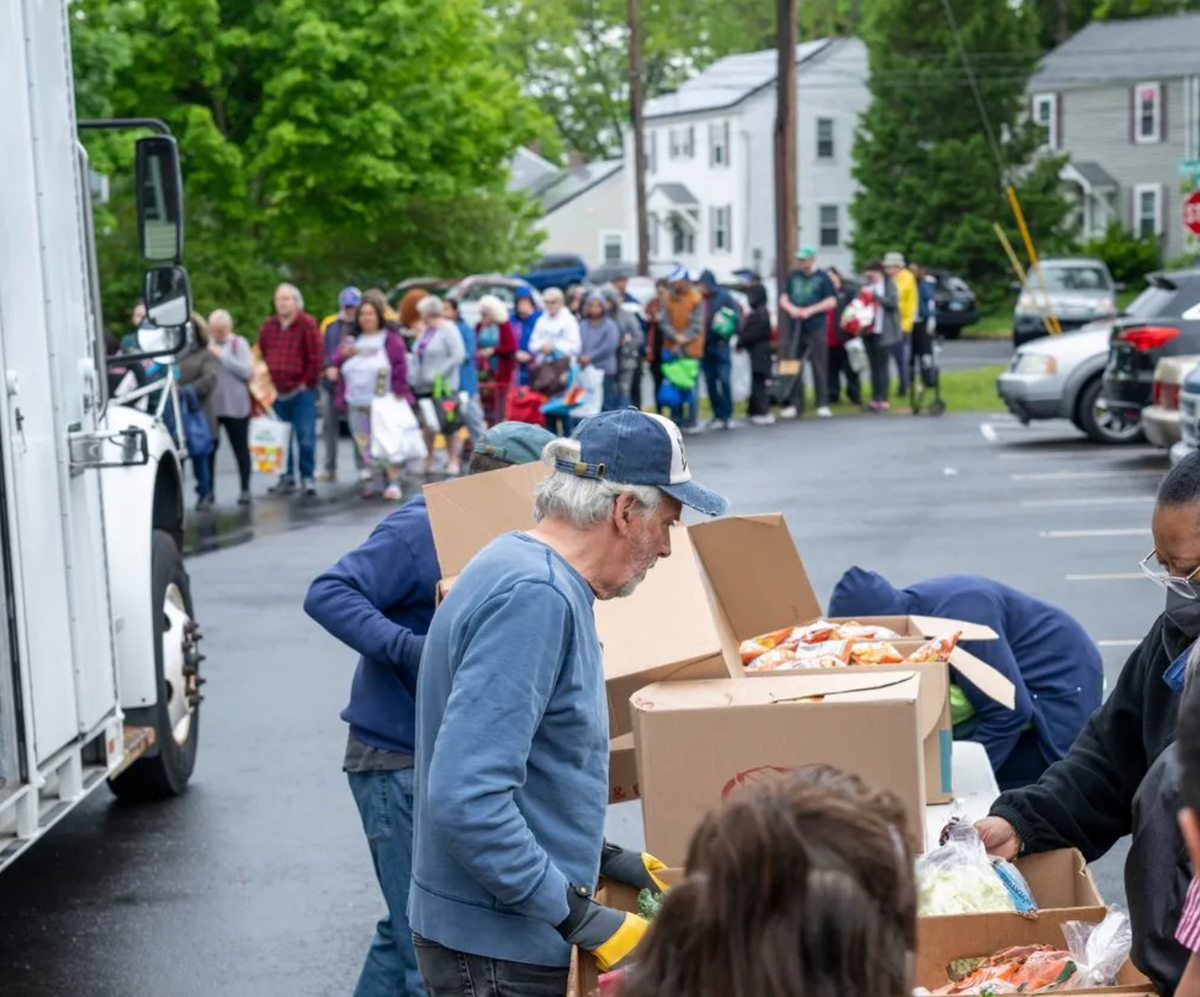
Imagine a world in which food pantries are no longer necessary.

Editor's note: For some time now, I have asked Pastor Dan for a sermon to be published on Thanksgiving. A contributor to Religion Dispatches and other worthy publications, he always delivers. Amid the din of voices in public discourse, I think his is one of the wisest, clearest and most hopeful. I know you will agree. May God bless you and happy Thanksgiving! –JS
I am not now and never have been a member of the Communist Party. And yet from time to time I think Old Man Marx had a point. He wrote in The Communist Manifesto for example that:
Nothing is easier than to give Christian asceticism a Socialist tinge. Has not Christianity declaimed against private property, against marriage, against the State? Has it not preached in the place of these, charity and poverty, celibacy and mortification of the flesh, monastic life and Mother Church? Christian Socialism is but the holy water with which the priest consecrates the heart-burnings of the aristocrat.
Marx, you see, didn't like charity. He thought that alms, handouts and relief helped the upper classes by putting band-aids on the pain and suffering caused by their exploitation of the workers, which in turn kept them in their place, instead of rising up against the aristocrats.
The church, as Europe's greatest dispenser of charity during the Industrial Revolution, was a natural target of Marx's critique. It was a time when millions of people moved off the farm and took jobs at factories. The economic effect was to create (or at least highlight) huge disparities in wealth. There were a very few rich people and a lot of poor people, and the question was: what do you do about all those poor people?
The church's answer was: you have to feed them. You can't just let them starve. But Marx countered that feeding the poor without addressing the reason they're poor in the first place doesn't really solve anything. Moreover, it's actually unjust. If you really want to help people, you'll change the system that made them poor.
Keep all of that in mind as you read a bit of an op-ed piece from the Washington Post.1 It was originally published in 2016, but it's as relevant today as it was then:
Food banks are a dominant institution in this country, and they assert their power at the local and state levels by commanding the attention of people of good will who want to address hunger. Their ability to attract volunteers and to raise money approaches that of major hospitals and universities. While none of this is inherently wrong, it does distract the public and policymakers from the task of harnessing the political will needed to end hunger in the United States.
Almost 180 years after The Communist Manifesto came out, we're still having the same conversation. The point isn't that food pantries or soup kitchens don't work. It's that they in a sense work too well: they create dependence, and they don't address the root causes of the problem. The donations you make to your local food pantry make a difference, and I urge you to give generously. But at a certain point I think we have to ask if the current system is effective, or should we be doing something else?
As for why we should ask that question on Thanksgiving — traditionally one of the biggest seasons of giving to food pantries and feeding programs — I think the reason is very simple. Part of gratitude is to share the wealth, literally. The book of Deuteronomy, for example, instructs its readers to give up the first fruits of their labor to God. Next, they were to thank God for those fruits and for the freedom from oppression they know because of God. After that, they were to share the product of their labor with immigrants and guest workers, orphans and widows and anyone else unable to provide for themselves. Giving thanks, according to scripture, means everyone gets fed.
So on this Thanksgiving, go, eat, drink and appreciate what you have. Watch some football and enjoy your time with family or friends. But as you give thanks before dinner, imagine a world in which food pantries and homeless shelters and charity of all sorts were no longer necessary. Picture that world, and what you might do to bring it about.
If you can't come up with anything, remember the bread you ate in the desert, the food that endures for eternal life, all the goodness and grace with which you have been fed in your life. Your job, our job, is to accept those gifts gratefully and pray and work that everyone else might receive them as well. This Thanksgiving, let gratitude be the start of justice, and justice the source of plenty, for all.
1. I've lost the source of this quote due to link rot and the abysmal state of search engines these days, but it's likely an excerpt from Andrew Fisher's Big Hunger: The Unholy Alliance between Corporate America and Anti-Hunger Groups.
To read more from Pastor Dan, visit his newsletter, Dandadad.