Francesca Hong's defeat was 'stunning' only if you believe the press corps' 'political fictions'
Beware those speaking with the voice of God.

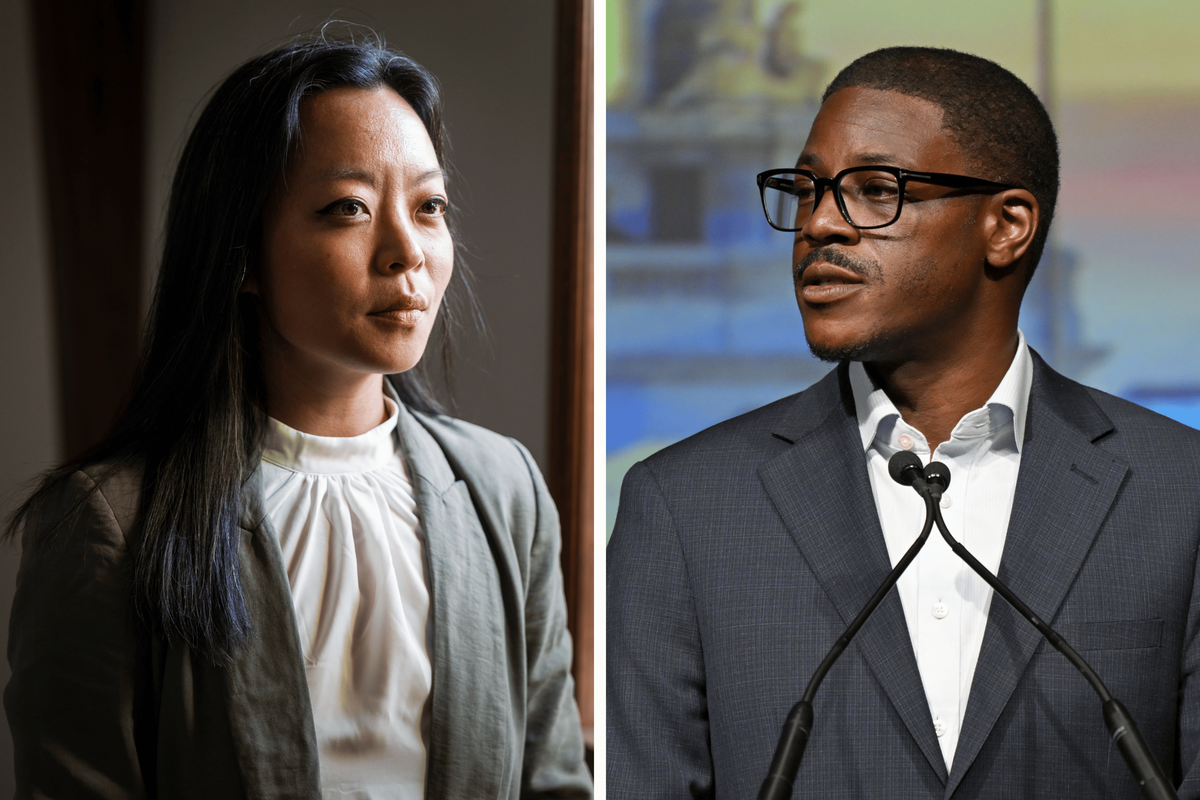
Democratic socialist Francesca Hong lost the Wisconsin primary for governor. In reaction, the Times ran this headline: "A Stunning Loss in Wisconsin Shows the Limits of the Left." And the lede: "The Democratic establishment finally struck back at the surging populist left."
Yeah, maybe.
I don't say that because I favor democratic socialism. (Regular readers will recall that I have issues with some forms of progressive populism.) I say "maybe" because the Times and others, but especially the Times, are in the habit of telling "narratives" that claim to explain intra-party conflict when in fact those "narratives" just confuse everyone and everything.
If Hong's defeat shows "the limits of the left," how do we explain the fact that Hong lost to David Crowley, the Milwaukee County executive, by a hair? How do we explain the fact that a fellow progressive won in a nearby state? (Minnesota Lt. Gov. Peggy Flanagan, whose politics overlap Hong's, won the Minnesota primary for US Senate.) How do we explain the fact, found deep in the weeds in the Times report, that neither Bernie Sanders nor Alexandria Ocasio-Cortez, the most popular progressive figures in the country, endorsed her?
Well, you can't. Anyway, no matter. The Times has a "narrative" and it's sticking to it.
What does explain her defeat is right there in the same Times report.
Tony Evers, the departing Democratic governor, weighed in at the last minute, warning that Hong would "probably" lose the general election to Republican Tom Tiffany, who is aligned with Donald Trump. Moreover, the primary itself was a mess. Crowley, believing there was no path forward, dropped out a month ago. After two party candidates left the race, he was encouraged to get back in, and he did. Meanwhile, Hong herself appears to have been unprepared for the spotlight.¹ The Times: "Even some socialists viewed Ms. Hong as a more imperfect messenger than other progressives this cycle." Adding drama to it all was polling that misjudged the anti-Hong vote, justifying the use of "stunning loss" in the headline.
To recap: The party opposed her. Progressives, in the form of Bernie and AOC, didn't support her. Her opponent's visibility was minimal until there was a frenzied effort near the end to push Crowley over the finish line. And Hong herself was not ready for the attention and scrutiny. Yet despite all that, she came very close to securing the nomination. That's not a "stunning loss." That's just a loss. Successful candidates for statewide office rarely win the first time. They must lose to get better. If Hong is smart, and she seems to be, she will.
But my point isn't about Hong or ideology. It's about the tendency of the Washington press corps to invent what Joan Didion called "political fictions" that compress often contradictory details into neat, coherent categories to tell a "narrative," in this case how "the Democratic establishment finally struck back at the surging populist left." The consensus opinion among political reporters, which is what constitutes "the narrative," appears to be that the Democrats must avoid seeming too extreme in order to win. So when a democratic socialist like Francesca Hong loses, that's a good thing. It was a "crisis-averted moment for mainline Democrats," wrote Politico's Jonathan Martin. There's some truth to it, I suppose, or rather some "truthiness" to it, as Stephen Colbert might say, but I think "political fictions" do more harm than good, as they warp our understanding and corrupt the choices we make.²
Let me put it this way.
I voted for Connecticut Governor Ned Lamont in yesterday's primary. I did so even though his challenger, state Representative Josh Elliott, is more my speed. What I like most is Elliott's position on the state's very obscenely rich. (Greenwich is known as "the hedge fund capital of the world.") He's tired of their phony excuses for refusing to pay their fair share. So am I.
Ned is rich, so he's nice to the rich. I voted for him anyway, because I am a conservative voter by nature, by which I mean I don't take risks. Ned has good values and has been a good governor. Progressives in the legislature can move him in the right direction. (For instance, state law now bans ICE agents from wearing masks.) But mostly, Ned is a sure bet. I know he can win a third term in November. That stability is appealing in the age of Donald Trump.
Does voting for Ned make me a moderate? Hardly. Does his victory mean the establishment "struck back against a surging populist left"? Yeah, maybe. You can interpret the details that way if you choose to, and that's my point. The Times and others, but especially the Times, behave as if they speak with the voice of God when in fact they are making human choices in the service of a "narrative" that they want to tell, for their own reasons, often in conspicuous contradiction to the very facts they report, with the added consequence being that they cannot be held responsible for those choices, as they were not choices, but acts of God.
David Crowley: "I especially want to thank Rep. Francesca Hong. Her campaign reminded people across Wisconsin that there are no long shots when it comes to believing in a better future and fighting to expand opportunities to every family ... the real opponent has always been Tom Tiffany."
— Aaron Rupar (@atrupar.com) August 12, 2026 at 10:09 AM
[image or embed]
I think what's happening to the Democratic Party is similar to what already happened to the GOP. It's transitioning. The parties are not static. They change over time. Assuming that dynamic in reporting about "insurgents" undermines "the narrative," so journalists leave it out and pretend that change within the Republican Party is natural and therefore legitimate, while change within the Democratic Party is a choice fraught with consequence and peril.
In reality, parties eventually achieve an internal equilibrium – a consensus – but only after a period of crisis. In the Republicans' case, that crisis was Barack Obama's election in 2008. In the Democrats' case, it was Trump's in 2016. The former turned fascist in response, rejecting multiracial democracy. The latter is turning into something new. I don't know what yet, but I think there will be more democratic socialism added to the existing mix of traditional liberalism and moderate pragmatism to create a diversity of views that reflects the diversity in the party. Importantly, after Trump's second victory, the median Democrat is no longer in the mood for compromise. She's not even in the mood for "checks and balances." After 500 days of tyranny, she wants blood, and the Democrats are trying to figure out how to deliver.
In time, I think the novelty of covering the Democrats' intra-party conflict will fade, as was the case with the Republicans after 2024, and perhaps that process is already starting to happen.³ Abdul El-Sayed might have been the outsider candidate when he first ran for Michigan's Senate primary, but the moment he became the Democratic nominee was the moment he became a part of the "Democratic establishment," whether existing members in good standing like it or not. If he defeats Mike Rogers, his Republican rival, "the establishment" will embrace him fully, even if begrudgingly, because he will be a winner, and winners make friends easily. Similarly, Wisconsin's David Crowley immediately brought Francesca Hong into his inner circle after beating her, pledging to go on a "unity tour" against his Republican opponent. Eventually, the Democratic Party will achieve consensus and a new internal equilibrium. Today's "insurgent" is tomorrow's "mainline Democrat."
Footnotes
¹ The Times reported: "The same polling that had her cruising to a victory in the primary showed her to be by far the weakest candidate for governor in the general election. Her campaigning style was unorthodox. She was soft-spoken on the trail and occasionally shaky in television interviews. And she sometimes struggled to explain old social media posts criticizing holidays like Thanksgiving and calling for the abolition of the police."
² I like this characterization of Didion's thesis in Political Fictions, in a review by a student at Yale in 2023. "The scariest point Didion seems to be making is not simply that politics is a nest of lies, but that we buy into 'the story' like any good novel. It is narrative in a completed, polished form. ... The narrative is made up of many such understandings, tacit agreements, small and large, to overlook the observable in the interests of obtaining a dramatic story line."
³ The illustration below intends to make fun of members of Democratic Socialists of America. They are noisy when they win, but they don't win at nearly the rates you would expect from people who make so much noise. That said, I think it's instructive, as it illustrates the continuum of sensibilities within the Democratic Party. Some are more popular than others, and probably always will be, but there is a place for each, depending on where and for whom. I don't want to seem kumbaya about this, as factional rivalries are serious and consequential, but it's important to keep this continuum in mind when encountering reporting that makes the Democratic Party all of one thing or all of another. That's a political fiction.