Why do the Republicans lie so much about Obamacare?
They want it to die, but don’t want to be seen killing it.
If you have been following the healthcare debate in Washington, you probably know that subsidies for those of us who buy insurance via state-based Obamacare exchanges are going to run out by year’s end.
What you don’t know is that that’s a false deadline. While the Republicans have until December 31 to make up their minds about whether to renew those tax credits, or do something else to address soaring premiums, the deadline for the rest of us is next week. I live in Connecticut. I have to decide whether to continue by Monday.
Something else you may not know: the healthiest among us have already decided. The Republicans do not want to renew the tax credits. They keep coming up with phony reasons why. Without an extension, our premiums will double, triple or quadruple. Sure, the Republicans might finally give in, and the tax credits might be applied retroactively, but what if they don’t. Are we expected to reup by Monday and hope that this president and this Republican Party will do the right thing?
Compounding the injury is the lying. The Republicans seem willing to say anything, no matter how preposterous, if it gets them out of being held accountable for their negligence. They say they can’t agree with congressional Democrats who want a clean renewal of the subsidies because Obamacare is a failure, because they don’t want to keep enabling insurance companies, or because there’s too much fraud.
Obamacare has constrained some costs, but it hasn’t kept up with health care providers who have conspired, yes, conspired, to fix prices. Like the media and other sectors, the healthcare economy has been consolidating into the hands of fewer corporations that have the power set prices that your insurance is forced to pay. There’s nothing wrong with Obamacare that antitrust law enforcement can’t remedy.
The Republicans say they want to skip over those insurance companies and give us money directly. Their latest bill would remit to someone like me $1,500 for a “health saving account.” Not only is this a pittance compared to what I save on my federal income taxes, it’s just stupid.
Why? Because the Republicans say we can take that money to shop around, thus incentivising health care providers to offer discounts. Sounds good but no one shops around. No one can! I have the expertise to choose between coffee shops, but I do not have the expertise to choose between heart surgeons. Do you? Of course not. To suggest otherwise is stupid. (Anyway, you know how far $1,500 would go?)
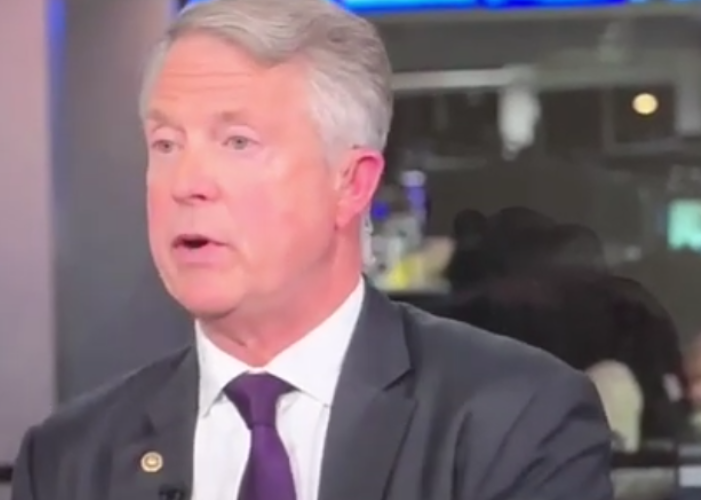
But perhaps the greatest insult to injury came out of the mouth of US Senator Roger Marshall. On CNN, the Kansas Republican said that his conference could not agree to extended subsidies if the Democrats do not address his concerns about fraud. What fraud? “A third of the patients that are on Obamacare right now did not file a claim last year for health insurance … So we think there's $25 billion of fraud. If we can’t get past the fraud issue, it’s going to be hard to go beyond this.”
I just … don’t know … where to … oh, FFS.
Look, as someone who buys insurance via Connecticut’s Obamacare exchange, I’m here to tell you that I cannot commit fraud. The only way for me to commit that crime is by lying on my income taxes.
I do not file claims. My doctor does. If there’s fraud, it’s on the provider side, not the patient side. Fraud would also require filing false claims, not no claims. And Marshall suspects fraud because a third of people are not using their insurance. Does he know how insurance works?
He does. He’s a doctor! But he’s also a Republican. As such, Marshall is looking frantically for ways to rationalize negligence, no matter how dumb. A sizable chunk of the president’s coalition is about to get screwed while a bigger chunk doesn’t care. All they know about Obamacare is that it has the first Black president’s name in it. There is no way of squaring that circle with the truth. So Republicans lie.
Don’t take my word for it. To cut through the Republicans’ lies, I interviewed Edwin Park, a professor at the Georgetown University McCourt School of Public Policy’s Center for Children and Families.
The GOP ignores facts “to push a long-term agenda away from group, pooled coverage to coverage in an unregulated market,” he told me. “That would return things to the way they were before the ACA: where people paid based on health and age and preexisting conditions.”
Here’s the rest of our conversation.
The Republicans do not appear to be willing to extend Affordable Care Act subsidies. They seem ready to send a few dollars to people so they can pay for health care directly. Why is this a mess?
It is very clear that congressional Republican leaders have zero interest in extending the enhanced ACA subsidies that expire at the end of the month. Instead, they intended to contribute some money to the health savings accounts of people enrolled in the ACA marketplaces. There are problems with this.
First, only some marketplace enrollees have health savings accounts in the first place. That's because the large majority of people receiving subsidies are in silver-level plans because you can also get help with deductibles and cost-sharing that way. HSA-eligible plans have to be much less generous bronze plans. So even if you switch, if you have a moderate or low income, you're probably worse off in terms of your out-of-pocket costs. Second, there's no way that a brand-new system to provide these HSA contributions could be up and running any time soon. The subsidies expire in three weeks and premiums could double.
The Republicans blame Obamacare for failing. They say it hasn't made health care affordable. That's true but the cause isn't what they say it is. It’s monopoly forces setting prices. Can you explain that?
Growth in health care costs have accelerated. Some of it is post-pandemic, where there has been an increase in use of healthcare services that were avoided or delayed during the worst part of the pandemic. Some of it is inflation, which is driving up operating costs for hospitals and other providers. And another factor is drug costs with newer drugs now having price tags of as much as seven figures.
That being said, economists have found that since enactment of the Affordable Care Act, health care costs overall have grown slower than expected. If we want to make premiums and other out-of-pocket costs more affordable, you need to build on public programs like Medicare and Medicaid to use their leverage to push down prices.
Medicaid, for example, gets the lowest net drug prices of any federal program (and much lower than Medicare and private insurance) by providing drug companies with a reason to give really big discounts. That allows Medicaid to ensure access for beneficiaries and cap co-payments for them to very affordable levels for low-income people.
The Republicans say people should be able to shop around for health care. In doing so, providers will compete, which in turn will bring prices down. Sounds great in theory except no one shops around. Can explain that and why aren't the Republicans getting it?
This is a very tired argument used to justify health savings accounts and even more radically, to justify moving away from insurance to paying for all health care by yourself. Individuals have no leverage to bargain down prices from hospitals, doctors and others. And that's especially the case when you have an urgent situation and you need immediate treatment at the emergency room. Also, every person is different. The cost of a service will vary by someone's diagnosis, circumstances, health and other factors. No individual non-medical professional will be able to assess what's a good price or not.
Conservatives and Republicans tend to ignore these facts as a way to push a long-term agenda away from group, pooled coverage (like programs like Medicare, Medicaid and the marketplaces and private employer-based coverage) to coverage in an unregulated market. And that would return things to the way they were before the ACA: where people paid based on health and age and preexisting conditions.
Let's not let the Democrats off the hook. As you say, there are solutions, at least in theory. Expanding Medicaid and Medicare. I would suggest enforcing antitrust law, too. From your view, what are the obstacles to reform? What would it take to achieve them?
There are certainly a lot of entrenched interests, including health care providers, insurance companies and drug companies. Also while the public supports universal coverage and cost containment generally, they have also been very resistant to major changes (at least initially). That is what we saw with the ACA. Its popularity is now at a historic high, but it was underwater for many years. And that is why Medicaid has never been so popular as it is today. The attacks on Medicaid in 2017 (that failed during the first Trump Administration) and the successful attacks on Medicaid this year (that culminated in the largest cuts to the program in its history) have heightened Medicaid's popularity and increased public awareness of how important it is.
Democrats have not coalesced post-ACA around large scale reforms, but have supported more incremental reforms like Medicare drug negotiation (passed as part of the Inflation Reduction Act) as well as opposing the cuts to the ACA marketplaces and Medicaid.
Circling back to your third answer: the Republicans are ideologically oriented so that they don't see, or can't see, that people must be put into pools in order to bring down costs. Does this orientation explain why they sound like they have no idea how health insurance works?
There are many congressional Republicans who knew what the cuts in HR 1 (“One Big Beautiful Bill Act”) would mean for Medicaid and the Affordable Care Act, but they didn't want to publicly oppose President Trump and their leadership. There are others who don't grasp all the roles that Medicaid (as well as other public programs) play today, such as in long-term care. That being said, there is a definite ideological bent for some who strongly oppose safety-net programs or who don't believe that healthier people should subsidize those who are sicker.
As I said earlier, they like the idea of going back to a pre-ACA world in which people with pre-existing conditions are charged more and can't afford coverage at all (with some modest spending for high-risk pools and the like to provide a little help the only concession).