Trump is 'worse than Carter'
The politics of the late 2020s may be as pivotal as the politics of the late 1970s.

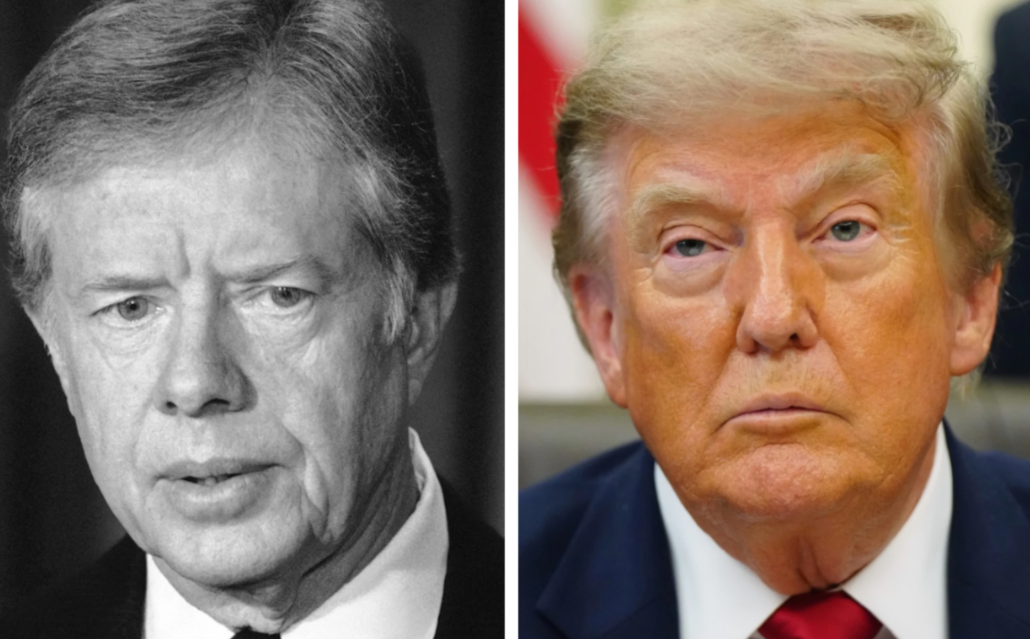
Historical analogies are always dicey but hoo boy, with the state of the economy, the price of oil, and a new round of polling, Donald Trump is giving off serious Jimmy Carter vibes.
I think Carter was a good president, but too many variables were out of his control, especially inflation. By the end of his term, it was over 10 percent. (It peaked at 13 percent in 1979.) Right or wrong, fair or not, he became known for inflation, or rather, for his inability to control it.
Inflation is only 3.4 percent right now. There is a long way to go before we get to the Carter years. But Trump is on course. Not only is he unable to control it. He's actively pushing it up with a trio of bad choices: illegal deportations, illegal taxes and, especially, an illegal war.
Carter faced oil shocks that drove up prices. Trump is causing oil shocks. The price of diesel broke records four days in a row. The price of gasoline is following suit. Those prices affect all prices, especially the cost of food. Just as everyone seemed mad at Carter, everyone seems mad at Trump. Disapproval of his handling of inflation is close to mainstream status.
A new Fox poll shows him 50 points underwater. A new Marquette University poll put that figure at 61 points. Not even Carter, whose presidency saw death by inflation, was that bad.
"Worse than Carter, worse than Reagan, worse than Biden," CNN's Harry Enten said. "He is worse than all three of those, and he is worse than any poll himself with this minus 61 points.
"Literally, the worst of all time."
Courtesy of CNN.
Inflation didn't just limit Jimmy Carter to one term. It discredited liberalism as a legitimate school of thought. Again, it's not really fair, because Jimmy Carter wasn't a liberal in terms of economic policy, but that's how he was portrayed by Ronald Reagan and his ideologues.
Reagan ended liberalism's dominance in 1980, that year winning all but 6 states.
A consequence of their propaganda was the public image of the New Deal and Great Society – federal programs advancing liberty, equality and justice for all – being too expensive. Better to abandon them, or enervate them, and we did in time. All of us live in a world of Reagan's creation in which normal workaday Americans wade through thickets of red tape to get public assistance while the very obscenely rich get handouts with no strings attached.
Carter's term was the turnbuckle. It was the end of one epoch – starting with the Great Depression and concluding with stagflation – and the beginning of another – starting with "supply-side economics" and concluding with whatever you want to call our current age of impunity and corruption. Eventually, it will have a name. In any case, it has the feel of an end-stage development. Something is going to break in this decade the way it broke in the 1970s.
The question is will Trump be identified with that break the way Carter was?
Leave a tip! Say $10? Thank you!
I don't know, but obviously a lot will be determined by Trump. It is widely understood that he defeated Kamala Harris, because the electorate trusted him on inflation. (Inflation was in fact falling in 2024, but not fast enough to catch up with public opinion, which has been formed during the pandemic.) He would bring prices down on Day One, he said. Then he didn't.
But not only has the president accelerated the already high cost of living with terrible choices. He won't take responsibility for them. Instead, he badgers voters into accepting inflation as the cost of ... well, no one is really sure. His reasons for attacking Iran have changed but the most often cited is preventing Iran from having a nuclear bomb. (Iran was not close to reaching that stage of development, but Trump can't be bothered with facts.) That goal, however, has not been enough even for his fiercest supporters, some of whom have taken to "begging" him on social media to end the war and bring diesel back to normal.
Carter has been on Trump's mind. In June, the Associated Press asked why he didn’t dispatch US Special Forces to remove Iran's uranium. “I didn’t feel like being Jimmy Carter," he replied.
"That recalled the failed 1980 raid to free US hostages that killed eight American servicemen," the Associated Press reported in July. "Trump also said in March that the unsuccessful mission 'cost them the election' against Ronald Reagan in 1980, sounding cognizant of political realities in a way he didn’t when using Carter as a punchline."
Yet Trump faces a hostage crisis of his own, only he's the hostage.
CBS News reported today the adviser to Iran's supreme leader said the Strait of Hormuz will remain closed until Trump and Israel's Benjamin Netanyahu are "removed from power."
"Our fighters will not open the Strait of Hormuz until they bring the criminal Trump and the bloodthirsty Netanyahu down from the seat of power," said Mohammad Baqer Zolqadr, the leading adviser to Mojtaba Khamenei, according to Iranian state television.
Carter's choices did not cause inflation. Even so, he was blamed. Trump's choices did cause inflation. Voters now seem ready to blame him in such numbers that even Texas looks like it's ready to flip. A new Sienna poll suggests that James Talarico, the Democratic Senate candidate, is six points ahead of Republican Ken Paxton (49-43 percent), Democratic gubernatorial candidate Gina Hinojosa is four points ahead of Republican Governor Greg Abbott (49-45 percent), and Democrats are nearly even in the generic ballot (Republicans' 47 percent to Democrats' 46 percent), which suggests an earthquake in the Texas legislature.
If that pattern held for two more years, and if the Democrats continued to make inroads, that would suggest another earthquake, this one national, as there is no path to victory for a Republican presidential candidate without 40 electoral votes from the Lone Star State.
No matter what happens in November's congressional elections, Trump will still be the president. He will still make terrible choices. And those choices will still push inflation up. (The Fed raised interest rates Wednesday and is expected to raise them again by year's end, but it might be a matter of too little, too late.) Two years is a very, very long time, long enough for Trump-blaming to become permanent, and long enough perhaps to discredit the maga movement and the ideological underpinnings of the last 45 years. The mainstream used to call "supply-side economics" a policy. By 2028, the mainstream might be calling it theft.
Trump's maga is the end-stage of Reagan's conservatism.
If Texas is lost, that might be the end of both.
I have made these historical analogies before, and I have been wrong too many times to have too much confidence in them. That said, our moment does have a familiar ring to it. The politics of the late 2020s may be as pivotal historically as the politics of the late 1970s. Epochal transitions are usually triggered by crisis. I used to think that was the pandemic. I used to compare Trump's first term to Carter's. But, perhaps, the real crisis has always been covid's long tail of inflation. I don't want to get ahead of myself, but history is rhyming.