Trump can try 'controlling' the Strait of Hormuz, but he can't control the reality of insurance
Iran can't be forced militarily. It must be enticed politically.

Axios published an exclusive story last night that accomplished what the president needs most: the public impression that the Iran war is ending and that everything's going back to normal. Read it here, but let me foreground three facts that undermine the story's premise.
- "Some US officials remain skeptical that even an initial deal will be reached."
- Among the skeptics is US Secretary of State Marco Rubio. Axios: He "called some of Iran's top leaders 'insane in the brain' and said it was unclear whether they would make a deal."
- And ceasefire terms are "being negotiated between Trump's envoys Steve Witkoff and Jared Kushner and several Iranian officials, both directly and through mediators."
Put these pieces together, especially the fact that Witkoff and Kushner are clowns, and you have more of the same game of kicking the can down the road. The White House says it "believes it's getting close to an agreement," but there's just as much reason to believe the White House knows that's nonsense. The war is not ending. The administration is trying to fool the public, especially the investors, into continuing to assume that the global supply of oil will be restored to pre-war levels, thus bringing down gas prices and dodging a recession.
Then there's the fact that the president speaks in terms of peace and war in the same breath. The peerless Aaron Rupar vividly put it this way: "It’s completely incoherent batshit lunacy."
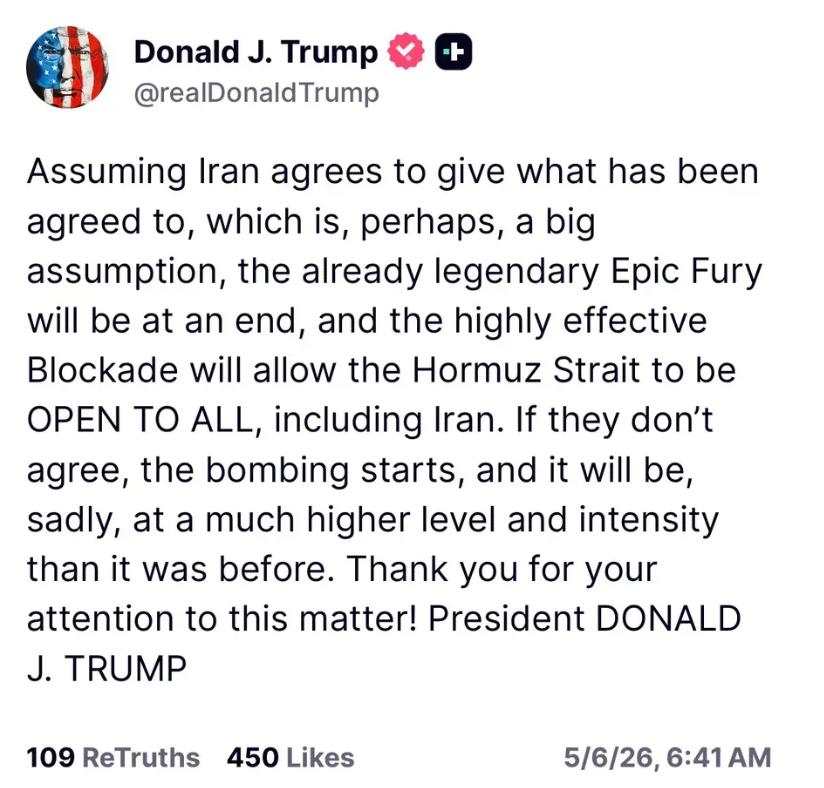
For all that, however, I don't think most people appreciate the depth of his lunacy. And I think that's because few of us understand what it means when Donald Trump demands that Iran "reopen" of the Strait of Hormuz. He's making it sound like there are rows and rows of Iranian battleships literally blocking the way in and out. If that were the case, however, the US Navy could just blow them up, allowing vessels laden with oil and natural gas to traverse.
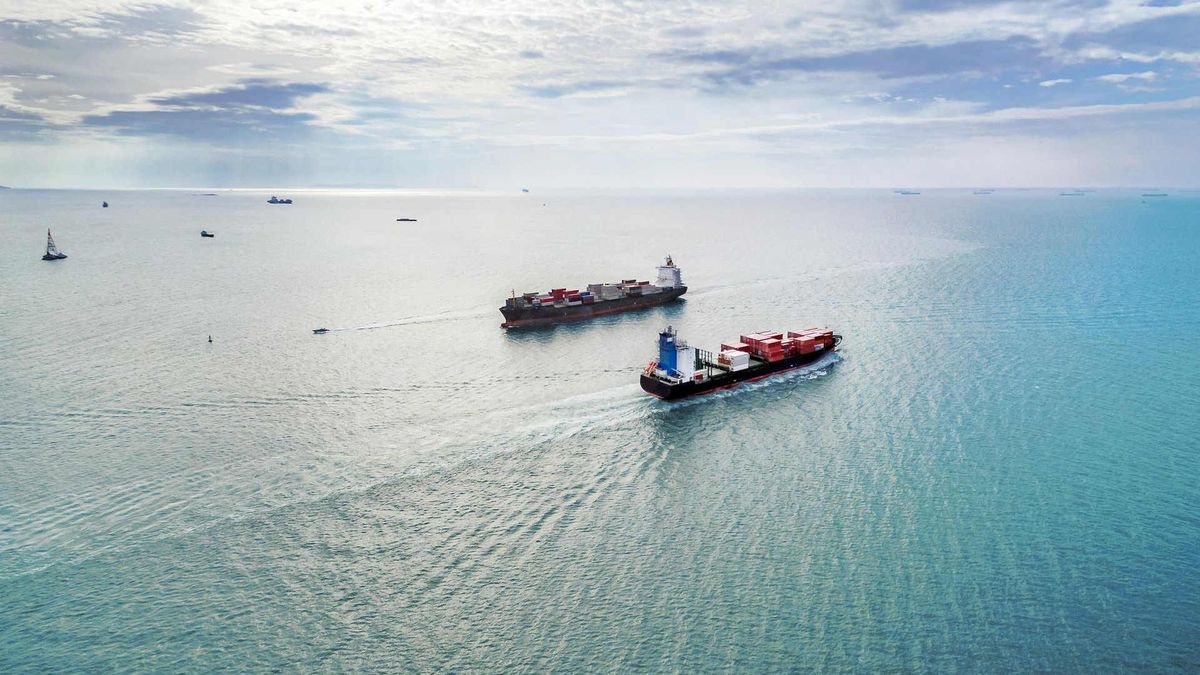
The truth is more complicated. It's not that Iran is blocking the strait. It's that the owners of these vessels – and more importantly, their insurers – are choosing not to go in and out. Why? They are scared. What are they scared of? Iran. The largest tankers are worth $100 million. Naturally, their owners and insurers fear what Iran might do to their property.
This is what news reports mean when they say that Iran has "effectively blocked" the strait. They mean the risk of damage and destruction to these multimillion-dollar vessels and their crews, which are carrying $200 million in oil or natural gas, is so great that their owners and insurers choose to essentially block themselves. When the president demands that Iran "reopen" the strait, he's demanding that Iran stop creating such a high-risk environment.
Importantly, the president cannot do much to significantly reduce the risk. He can threaten to resume bombing "at a much higher level and intensity" if Iran's regime does not "reopen" the strait. (He can, for that matter, threaten to murder a "whole civilization" if they don't agree to his terms). He can order a naval blockade of Iranian ports of call. He can tell the Navy to escort every vessel in and out of those international waters for the next 20 years.
He can control a lot.
But he cannot control the reality of insurance.
For all the bragging about tactical accomplishments – "they have no navy left ... they don't have an air force ... that's a very substantial achievement," Secretary of State Marco Rubio reminded us – the fact remains that there are no military options available to the president that can guarantee that one drone sent by one drone operator would not find a way to blow a hole in just one of those supertankers. As James Mattis said recently, Iran has "anti-ship cruise missiles that could be fired off the back of a pickup truck that can go 100 miles."
"There's the problem," Mattis said.
The White House keeps saying that the US has the advantage, but what does that mean when Iran can accomplish so much for so little? What does "advantage" mean when the US can accomplish so little for so much? (The Pentagon says the war has so far cost $25 billion. The Post reported today that Iran has attacked "at least 228 structures or pieces of equipment at US military sites." Damage to the US base in Bahrain is so "extensive," a US official said, that the headquarters had to be relocated to Tampa. The official told the Post that it's unlikely that "troops, contractors or civilian employees will return to the base 'anytime soon.'")
Trump said the US has "total control" of the strait. Treasury Secretary Scott Bissent said the US has "absolute control." US Senator Lindsay Graham, a Republican, was less certain, but confident. Once the US takes control, he said, that's "checkmate." Wish-casting, all of it.
Ships are choosing not to enter out of fear. Trump can't make them. The strait will "reopen" when Iran decides to stop scaring everyone. It can't be forced militarily. It must be enticed politically. That's going to be hard not only because the president needs Iran's help in cleaning up the mess he created. (After all, Hormuz was open before Trump agreed to Benjamin Netanyahu's hare-brained scheme.) Harder is the fact that Iran now has something more valuable even than nuclear weapons. A superpower won't beg for peace over a bomb.
But it might over Hormuz.
That's all for today. Please consider subscribing! I know you like it. I know you'll love the price! For just $9 a month, you get so much, plus the satisfaction of supporting independent journalism. (Don't know if you're a subscriber? Check your status below.) –JS