By gutting the Voting Rights Act, the Supreme Court made an enemy of the Democratic Party
The party can longer afford to play along with the supermajority's make-believe.

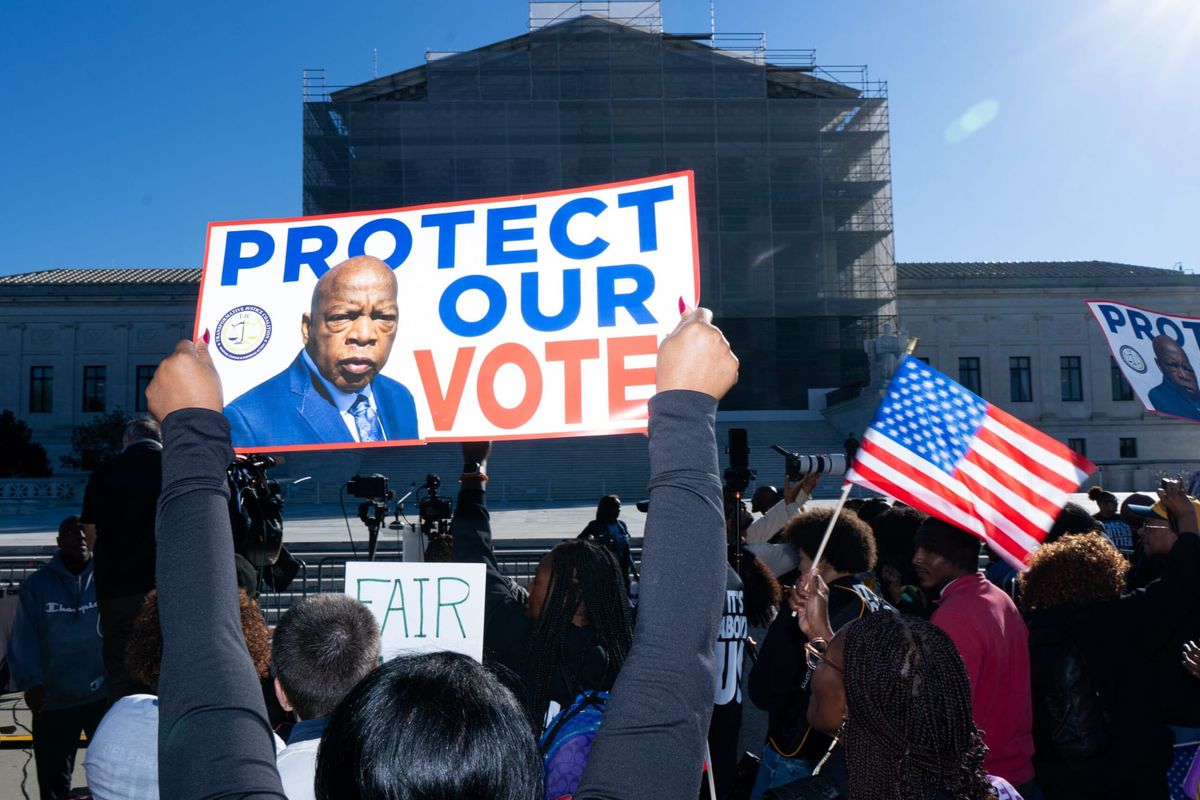
How do I explain what the supermajority of the US Supreme Court did yesterday to the Voting Rights Act? I'll put it this way. Six justices decided to pretend that racism no longer exists and that the history of racial discrimination no longer bears on the present. The gravity of their ruling cannot be overstated, but the ruling itself was based on fantasy.
The point of the 1965 Voting Rights Act (VRA) was ensuring equality. Everyone involved in its passage, which arose from overwhelming support in the US Congress, knew the point was to codify the ennobling principles of the founding. And everyone involved understood the primary challenge to that goal: racial discrimination, especially in the former slaver states.
The history of slavery and Jim Crow apartheid is why the VRA's Section 2 allowed race to be a factor in drawing congressional maps. The idea was that remedies to racial discrimination should be race-conscious. After all, how do you reverse the effects of the history of slavery and apartheid, as well as make reparations to future citizens, without an awareness of race?
Before you continue reading, I want to encourage you to subscribe to the Editorial Board. I know you like it. I know you'll love the price! For just $9 a month, you get so much, plus the satisfaction of supporting independent journalism. (Don't know if you're a subscriber? Check your status below.) –JS
To rightwingers, the VRA was never the manifestation of the Declaration of Independence. It was always a weapon against "innocent" white people. For years, rightwing courts tried to gut it. Yesterday's ruling is a result of that history. Six justices pretended racism isn't real – or not real enough to justify the provision's continuation. By make-believing, they rationalized a ruling that found that race-conscious remedies to racial discrimination are actually racist.
Here's what Associate Justice Samuel Alito said in the court's majority opinion on the constitutionality of a district in Louisiana that is majority Black. "Section 2 of the Voting Rights Act … was designed to enforce the Constitution — not collide with it. Unfortunately, lower courts have sometimes applied this Court’s [Section] 2 precedents in a way that forces States to engage in the very race-based discrimination that the Constitution forbids.”
To put this another way, what Alito is saying is hooray! The VRA did it! The United States is no longer as racist as it used to be! And because the mission is accomplished, the Supreme Court cannot continue to allow race to be a factor in drawing congressional maps. If it did, that would mean a law designed to enforce the Constitution ends up colliding with it. The only constitutional way to draw congressional maps is by being completely "blind" to color.
It's hard to avoid the conclusion that Alito is gaslighting us. Plaintiffs must now show that states intentionally discriminated against minorities. That's going to be difficult to prove, however, in courts that are now constitutionally mandated to pretend to be colorblind.
Already subscribing? Give the EB as a gift!
In that, Alito is merely building on the original gaslighting by Chief Justice John Roberts. In 2013, in a ruling that opened the door to yesterday's, he said "it is a sordid business, this divving us up by race. ... our country has changed, and while any racial discrimination in voting is too much, Congress must ensure that the legislation it passes to remedy that problem speaks to current conditions." In response, the late Ruth Bader Ginsburg reminded Roberts that racial prejudice is a condition demanding constant vigilance. "Throwing out preclearance when it has worked and is continuing to work to stop discriminatory changes is like throwing away your umbrella in a rainstorm because you are not getting wet.”
Of course, no one in America is blind to color! Remember the point of the Voting Rights Act: to ensure equality in the face of real racial discrimination. It didn't make bigotry disappear. By gutting this key provision, however, the Supreme Court has paved the way for its resurgence in election law, and predictably, that's what happened. Within hours of the ruling, Florida, Mississippi and Louisiana – former slaver states – moved to redraw their maps to suppress the freedom of their minorities. (Tennessee and Alabama followed on Friday.)
The Washington press corps almost uniformly framed news of the ruling in terms of the midterms, as in: which of the parties will have the advantage in light of the court's decision? While it's true that it supercharges a bipartisan gerrymandering effort already underway, it does much more than that. The ruling, according to Hofstra Law Professor James Sample, "is a diametrical shift in voting rights practices, a diametrical shift in the areas of race and racial discrimination and the remedies for racial discrimination." Elections are only a means to an end. The ruling's ultimate outcome will be restraining the ability of nonwhite people to manifest their destinies, making them a separate class of citizens that is not equal.
The Supreme Court is returning America to its original racial caste system.
However, the ruling's impact on elections is probably what will finally get the full attention of Democratic leaders. While the party has successfully countered GOP gerrymandering efforts in Texas, the court has dismantled some of the last remaining obstacles to restoring the legal structures of southern apartheid, thus increasing the odds of continued Republican dominance in Washington. In short, the ruling poses an existential threat to the Democratic Party's future. Perhaps that will finally force the party to regard the court as its enemy.