Totalitarian ambition, but not yet totalitarian control
“Free America is down, but not permanently out.”

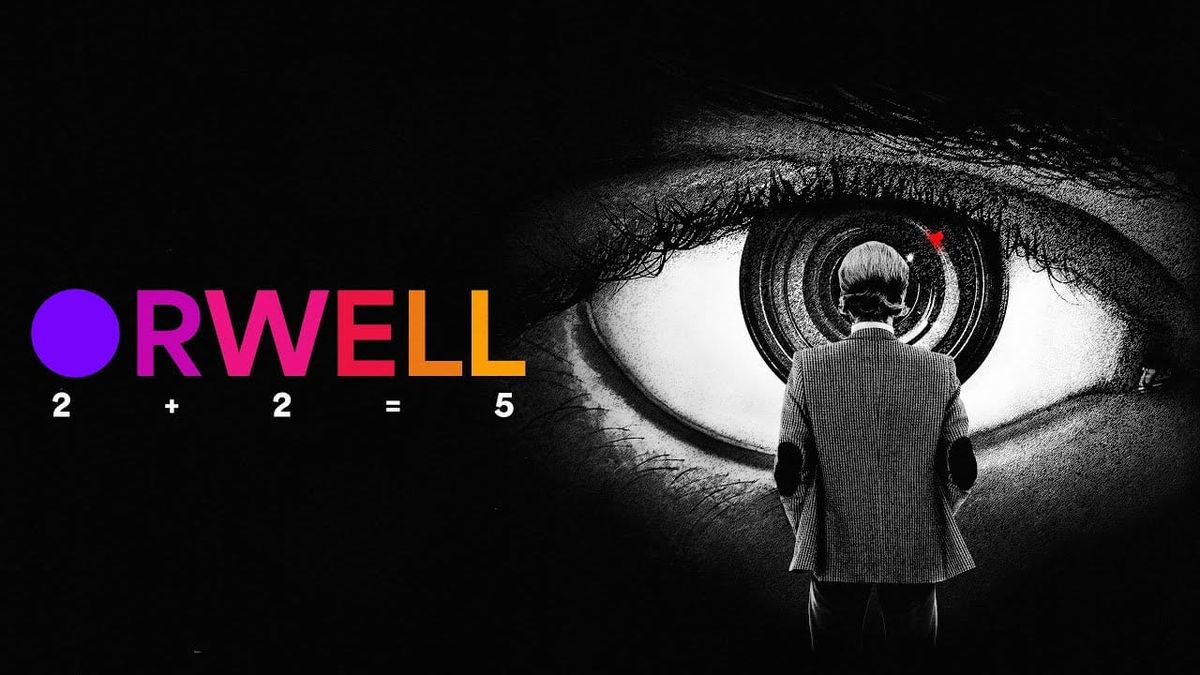
Last weekend, I went to Hartford to see the new documentary about the life and work of George Orwell. It’s called 2+2=5. I’m familiar with his work, especially his essays, which are his most natural medium. Even so, something new popped out at me and I wanted to share it.
The film takes Orwell’s thinking about the politics of the early 20th century and lays them over current events around the world, but especially in America, in such a way that a bridge between past and present comes into view. I have said America is experiencing a drift toward totalitarianism, but I did so in an intuitive way. After watching the documentary, however, I’m more confident in that being true.
I encourage you to see the film.
Let me give you examples drawn from Orwell’s “The Prevention of Literature,” an essay that the documentary quotes frequently. In this one, it’s like he describing the Republicans under Donald Trump:
“A totalitarian state is in effect a theocracy, and its ruling caste, in order to keep its position, has to be thought of as infallible. But since, in practice, no one is infallible, it is frequently necessary to rearrange past events in order to show that this or that mistake was not made, or that this or that imaginary triumph actually happened.”
Here, it’s like Orwell is describing all those media barons and their “intellectuals” who bend over backwards to rationalize the abuse of power, even at the expense of endangering their own liberties:
“Let me repeat what I said at the beginning of this essay: that in England the immediate enemies of truthfulness, and hence of freedom of thought, are the press lords, the film magnates, and the bureaucrats, but that on a long view the weakening of the desire for liberty among the intellectuals themselves is the most serious symptom of all.”
He seems to be describing Fox here: “What is new in totalitarianism is that its doctrines are not only unchallengeable but also unstable,” he said. “They have to be accepted on pain of damnation, but on the other hand, they are always liable to be altered on a moment’s notice.”
Finally, Orwell explains why we feel crazy watching the news:
“Totalitarianism, however, does not so much promise an age of faith as an age of schizophrenia. A society becomes totalitarian when its structure becomes flagrantly artificial: that is, when its ruling class has lost its function but succeeds in clinging to power by force or fraud. Such a society, no matter how long it persists, can never afford to become either tolerant or intellectually stable.”
It seems pretty clear to me what’s going on, but I wanted to check myself against someone who has studied actual totalitarian regimes. So I interviewed Nicholas Grossman. He’s a political scientist at the University of Illinois and a senior editor of Arc Digital. Indeed, he said, we are seeing “totalitarian ambition,” but not yet “totalitarian control.”
“Free America is down, but not permanently out.”
I just watched 2+2=5, the new documentary about the life and work of George Orwell. I used to be a little bit squeamish – a little – about applying "totalitarian" to Trump and the Republicans, but no longer. What do you think? Are we living through a totalitarian age?
No, because the state doesn’t have anything close to total control. But we do face movements that could fairly be called totalitarian in their ambitions. Hannah Arendt distinguished totalitarianism from other forms of authoritarianism in that totalitarians seek to control private behavior, not just government and public sector, and use psychological, not only physical, repression.
By that definition, Trump and maga demanding widespread praise for Charlie Kirk, or trying to erase transgender identity, or the many other ways they’re using governmental and state-connected corporate power to try to control culture, speech, and private behavior, indicate totalitarian ambition. But as the Jimmy Kimmel case shows — to pick one example — they are far from totalitarian control.
I reread one of the essays that the documentary sources. In “The Prevention of Literature,” Orwell says a totalitarian society is a theocratic society. The leader must be seen as infallible. History and facts must be bent toward that end. As applied to Trump, correct?
Similar to my answer to the first question. Trump clearly wants supporters in Congress, the media, and the public to act like his words outweigh factual reality. He wants everyone else to pretend his lies are real, even if they’re obvious nonsense or directly contradict something he said recently. But they don’t have the power to really enforce that.
Take the example of the “No Kings” protests, or how many people publicly call Trump a liar. Nothing like that happens in North Korea.
In fact, the White House seems to be daring the “No Kings” protest to challenge him without seeming to understand that that's what the “No Kings” protesters are really going to do: challenge him. What are the Republicans thinking in trying to characterize Grandma and people dressed as frogs as if they're part of a terrorist network?
It’s their go-to move: lie incessantly about supposedly dire threats and claim those threats entitle them to drastic action, including rights violations and law-breaking. They might not know any other reaction.
In fairness, the demonization and lies have worked for them a lot, helping them gain national power and operate outside the law. But that’s why individual protestors wearing goofy costumes, and large peaceful protests full of regular Americans, apparently frighten them. When the public sees a dancing frog or a grandma holding a sign, they unavoidably see that Trump, Republicans and maga media are lying.
One of the threads of totalitarianism that Orwell explored is the weakening of the desire for liberty among people who would otherwise be expected to desire it. He meant the intellectuals. Today we would call them "radical centrists." They reacted against woke politics. They rationalized Trump 2.0. That seems totalitarian-lite.
Trying to force the media and universities to toe the party line, ban discussion of facts that the government doesn’t like, and parrot the Trump administration’s self-aggrandizing lies arguably fit that.
I think it’s hyperbolic to call reactionary centrists “totalitarian,” though they can be apologists and handmaidens for totalitarian-minded political forces. But it’s fair to say that some intellectuals who should naturally desire liberty are instead rationalizing, excusing, even advocating the Trump-led government forcibly taking away liberty.
Well, at least other people’s liberty.
The goal of a totalitarian state is to make it impossible to tell what's true and what's false. The rightwing media complex is vast and getting bigger. The surveillance state is also getting bigger. We are heading toward Big Brother (the villain in Orwell’s 1984), yet the old Cold War liberalism seems to have been forgotten. Thoughts?
The consensus of Cold War liberalism feels like the distant past. Calling the US president “leader of the free world” now sounds like a sick joke.
But America is vast, with a deeply embedded liberal and democratic culture. Trump, Republicans, and maga are unpopular, and the rights-violating secret police of ICE are more unpopular still.
Free America is down, but not permanently out.
It’s like we’re in a race: can Trump, the Republicans, and their allied oligarchs establish enough control over governmental institutions and the information environment to lock in undemocratic control? Or will their un-American actions plus opposition get them out of power first?