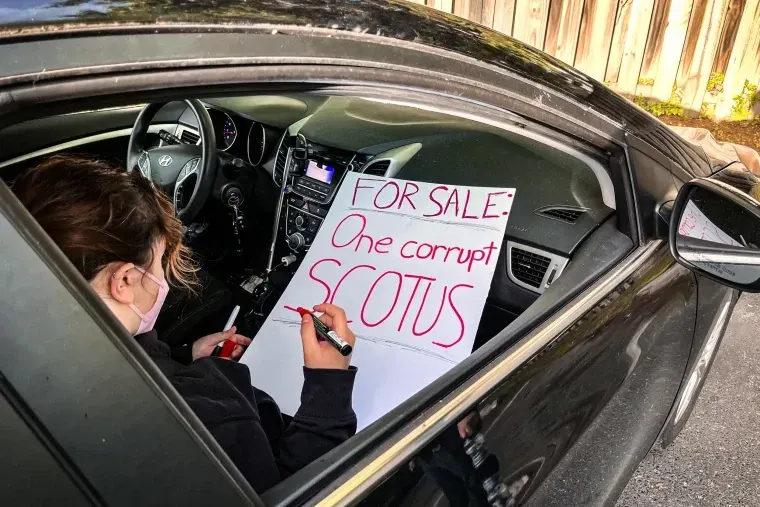
SCOTUS is so corrupt that it operates in secret. Punish it
No democracy can endure when justices are untouchable.

Editor's note: Today's edition goes out to everyone. If you're not subscribing, consider doing so today. The newsletter is how I make a modest living. It's how I pay the rent! I can't do this alone. Please join us. Link at the bottom. (PS: Don't forget the tip jar! Thanks!) –JS
The American republic dodged a bullet yesterday when the US Supreme Court decided to uphold birthright citizenship. If not for two Republican justices, who refused to make-believe their way through a plain reading of the text of the 14th Amendment, we would have seen the clock turning back to a time after the Civil War when politicians were debating whether formerly enslaved people and their children were actually United States citizens. We came too close to destruction to consider anything short of a maximal response. For years, some Democrats talked about reforming the court. I think it's time they talked about punishing it.
Reforming the court as an institution – term limits, for instance – might deter future malfeasance, but the court is behaving badly now. It acts as if its benefactors will move heaven and earth to protect it, allowing it to rule with impunity for the law. To me, it's simple. Stop bad behavior by punishing it. No democracy can endure when a half dozen high priests of the law are untouchable. Punish the court by impeaching and removing a justice.
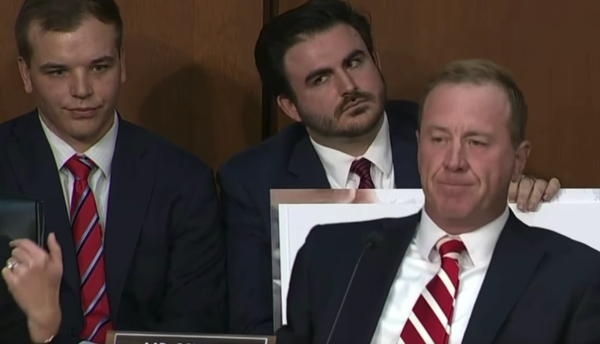
This kind of thing used to sound fringe-y. Democratic activists who lost faith in the high court, due to Brett Kavanaugh's confirmation in 2018, called for his impeachment a year later when the Times revealed that he almost certainly lied to the Senate about allegations of inappropriate sexual behavior. His critics were small in number but loud enough to get the attention of Democratic presidential hopefuls like Elizabeth Warren and Kamala Harris, who joined their calls. Still, the focus was on just one man. These days, the focus is much broader.
In the summer of 2024, New York Congresswoman Alexandria Ocasio-Cortez filed two articles of impeachment, one against Clarence Thomas and one against Samuel Alito, alleging that both men did not disclose gifts provided by wealthy patrons, nor did they recuse themselves from cases involving them. ProPublica reported in 2023 a pattern of behavior spanning decades in which Alito took luxury vacations paid for by a Republican billionaire who later had cases before the court. Also from ProPublica that year came numerous reports on similar conflicts by Thomas. (The article of impeachment against Thomas includes his wife's legal interests. Virginia Thomas was indirectly involved in the J6 insurrection.)
Ocasio-Cortez's articles focused on justices, not their rulings, but Steve Cohen's did. The Tennessee Congressman, who was gerrymandered out of a job thanks to the court, filed six articles of impeachment in May against Chief Justice John Roberts on the charge of "violating the Constitution, disregarding his statutory obligations as chief justice and breaching his oaths of office." The court's rulings, Cohen alleged, were "for the rich and powerful at the expense of the poor and the broader citizenry." Under Roberts' stewardship, Cohen alleged, the court has become "biased" with "decisions designed to benefit Republicans at the expense of representative government," "a pattern of ethical breaches that raises questions about the role of the wealthy" and "seemingly contradictory and unexplained orders."
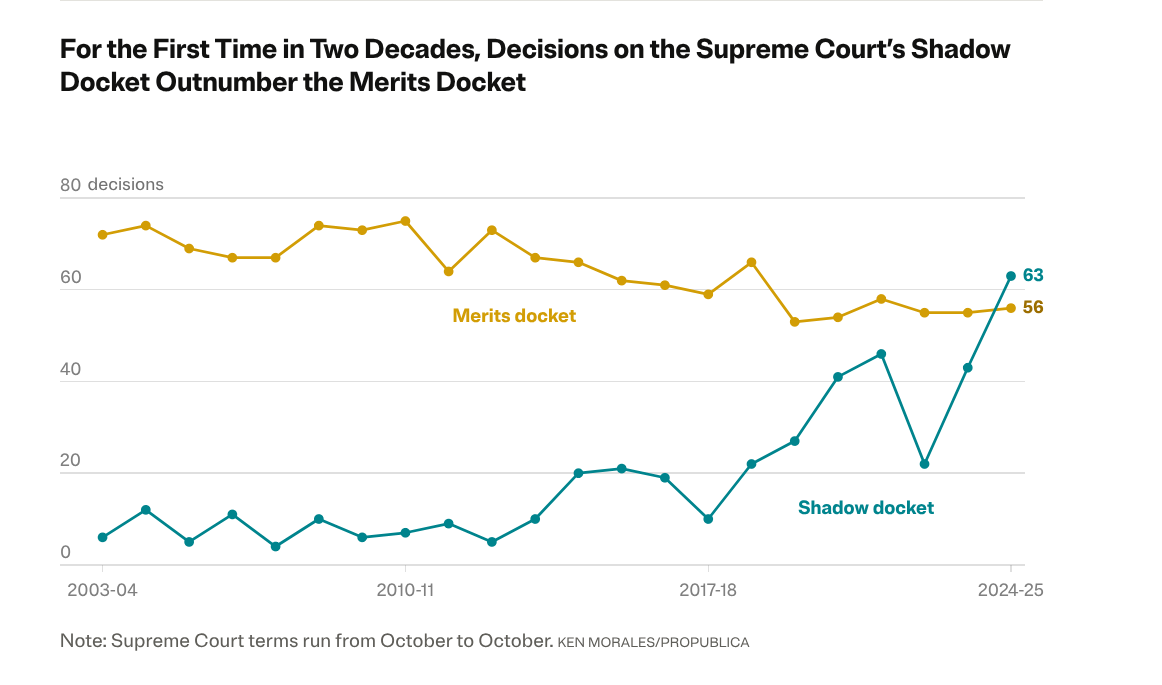
That last part – about "contradictory and unexplained orders" – is finally getting more attention. Today, ProPublica reported that last year, for the first time, justices decided more cases in secret than they did in open court. ProPublica analyzed over 20 years of rulings and found that "when the last court term ended, justices had issued 63 orders on the shadow docket, as opposed to 56 orders on the more traditional merits docket — where the court hears oral arguments scheduled months in advance and the justices issue signed opinions."
By using the shadow docket, the court can decide cases fast, without deliberation, scrutiny or accountability, as orders are often handed down unsigned. And doing so has been to the benefit of the court's chief sponsor. "Increased willingness to bypass its regular process has empowered President Donald Trump at the same time as the administration has increased use of executive authority," ProPublica reported. "The court has repeatedly green-lit policies of his that lower courts have blocked — and has done so with little to no explanation."
Just as it is plainly obvious that the 14th Amendment says all persons born in America are American, it is plainly obvious that when the highest court in the land operates in secret, it's corrupt – and must be punished for its transgressions. In commenting on the ProPublica story, attorney Max Kennerly said that "the GOP Supreme Court does not even bother to explain the majority of its decisions. It's apparently too much to ask they at least barf up dishonest, unprincipled, poorly-reasoned excuses for their arbitrary exercise of power."
"By itself," Kennerly said, this is "cause for radical reform."
By itself, he said, this is "impeachable."
 John Stoehr
At this point in the story, the question is whether punishment for obvious high crimes and misdemeanors is possible in a political system that's really a cartel in all but name. A high court has paid one of the parties for protection, in the form of legal immunity, so that both can continue to act with impunity for the law. It takes a simple majority to impeach in the House, but it takes a supermajority, two-thirds of the Senate, to convict. The bar is so high that removal is practically impossible. Just talking about justice feels futile. I think that's why, when it comes to the Supreme Court, most of the discussion ends up being about reforming it in order to prevent wrongdoing in the future. Clarence Thomas said he's "just walking" when asked why he's strolling around Capitol Hill. He clearly believes no one can touch him.
He will be right if no one tries.
For the Democrats, the path toward taking control of the House has long been clear. The path toward retaking the Senate is now shaping up. Today, the Times said that new polling suggests that Senate seats in Alaska, Iowa, Maine, North Carolina, Ohio and Texas are all toss-ups. The Democrats need only four seats to control the chamber, but even if they swept them all, it wouldn't be enough to punish a justice by themselves. They would need at least 14 Republicans to join them (assuming all 53 of the Senate Democrats were on board). Unless it's seen as a cynical ploy to replace an old reactionary with a young one, the odds of that happening are low. But this is about crime and punishment, the administration of justice.
Whether it's popular should be beside the point.
That's all for today. Please consider subscribing! I know you like it. I know you'll love the price! For just $9 a month, you get so much, plus the satisfaction of supporting independent journalism. (Don't know if you're a subscriber? Check your status below.) –JS