Liberalism can save Christmas from Trump
The real enemies of religious liberty have revealed themselves.
I don’t know when it started exactly, but I remember Fox complaining about liberals taking the “Christ” out of Christmas as long ago as 2005.
Back then, I was a reporter for the Savannah Morning News in Georgia. In the fall of that year, a Fox personality by the name of John Gibson had published a book called The War on Christmas: How the Liberal Plot to Ban the Sacred Christian Holiday Is Worse Than You Thought.
Gibson argued that liberals were trying to secularize everything, by which he meant trying to make everything Godless. Specifically, he accused them of attacking the right “to practice our faith in daily life,” eroding it “to such an extent that we must hide behind closed doors to celebrate a traditional holiday,” according to a blurb on the back cover.
In a feature for the Morning News, I put Gibson’s allegation in context by interviewing historians at local universities*. They told me that Christmas as practiced in America has always been more about shopping than faith, and even that was relatively new. The Puritans hated Christmas. They thought it was pagan or worse: Catholic.
Looking back, I see I made a mistake. Gibson’s allegations were not sincere. They were lies aimed at dominating the contours of national debate over struggles implicit in a diverse society. That’s among the chief goals of rightwing politics: controlling how we talk. But I wanted to be seen as reasonable, so I accepted malign intent as if it were good.
Without making too much of it, my error was the kind of conduct that, having been repeated enough, has contributed to what we have now. After two decades of propaganda about the “war on Christmas,” during which reasonable people like me accepted bad faith as if it were good, an evil regime has risen to do what Gibson accused liberals of doing.
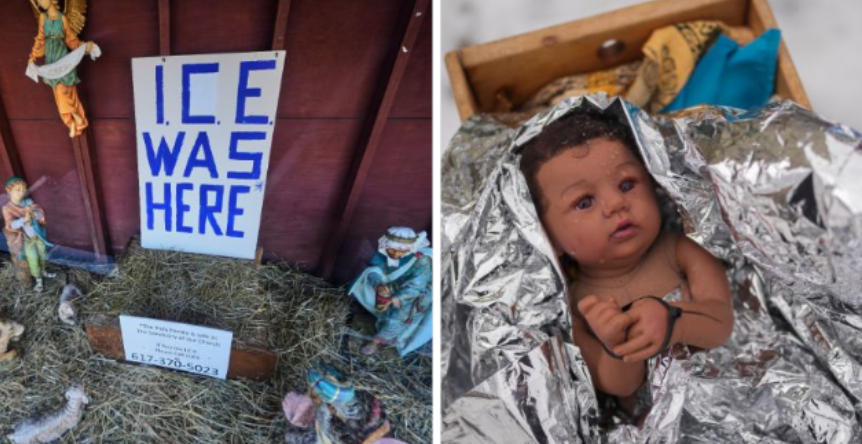
Among other outrages, immigration authorities are now ordering church leaders to take down Nativity scenes that protest the injustice of snatching immigrants without due process. Some Nativities have baby Jesus in a zip tie or “ICE was here” in his manger. These are not merely political protests. They are expressions of religious liberty. “This nativity is a visual reminder … that the attacks on our immigrant neighbors are attacks on God's own self,” one pastor told People.
But that’s small beer compared to a plan to raid Spanish-language congregations during Yuletide. Last month, journalist John Keough confirmed that US attorneys in New York, Massachusetts and Rhode Island have been briefed on it. He also interviewed a Hispanic pastor of a Pentecostal church in New England, who said federal agents asked “questions about the names of specific congregation members, their home addresses, and the frequency they attended church services.”
The regime hasn’t banned Christmas yet.
But it’s going to war.
While the regime’s behavior reveals the hypocrisy behind conservative concerns about religious liberty, it recalls something else, according to Paul Rosenberg, a contributor to Al Jazeera English and Salon.
The origins of liberalism.
Specifically, the religious wars in Europe from which it arose.
“Liberalism is in large part an evolution out of the dogmatic conflicts that threatened Europe’s destruction for nearly two centuries before America’s birth as a nation,” Paul wrote recently for Liberal Currents.
"Conservatism, for reasons that remain unclear, now appears to want to revisit and recreate the trauma that liberalism evolved to recover from. Nothing could make that clearer than the threat of targeting Spanish-speaking churches nationwide during the holiday season," he added.
Liberalism was never against Christmas, but it might save it.
Paul spent a little time with me. Here’s our discussion.
After years of hearing about a “war on Christmas,” here we are. Yet I don't see any religious conservatives complaining. What's going on?
It's always been a political project, rather than a religious one. Bill O'Reilly at Fox News was the main propagandist and religious conservatives were happy to go along. But the impetus never came from them. It was merely a matter of convenience. Now they're silent, also a matter of convenience. So nothing's changed, really.
Yet the consequences to religious liberty of religious intolerance are clear. In Liberal Currents, you expand on that. Explain a little for me.
The issue of religious liberty came to the fore with the Reformation and the religious wars that followed. But those wars were political as well, and religious liberty for rulers could just as easily put them at odds with their subjects. So it wasn't a clearcut battle of ideas, as some today might want it. It was very messy and had many wrinkles.
But the practical upshot was that it proved impossible to restore the shattered ideal of one ruler and one unified faith, because no one had the power to enforce that. There had to be compromise.
Two waystations in the journey to where we are today were the 1555 Peace of Augsburg, which allowed rulers to choose either Lutheranism or Roman Catholicism (but not Calvinism) as their official state religion. Then their subjects had to follow. Naturally, this was unstable.
The second was the 1648 Peace of Westphalia, which expanded the options to include Calvinism and allowed subjects to choose their religion for themselves. There were still many left out, so it wasn't fully stable, but was a lot more stable than what had gone before.
Most folks did have significant religious freedom at this point, but it was imperfect enough that folks migrated to be able to worship as they chose – first within Europe, then to America.
You suggest that religious conservatives have been gaslighting us into thinking their real concern was orthodoxy. By backing Trump, we know that's not true. How would liberals of the past react to that?
"Liberals of the past" may be the wrong way to think about this, since the process of sorting things out played a big role in shaping what liberalism came to mean, and that meaning evolved over time.
But what they did have in common was concern for both liberty (religious liberty is our focus here, but their concerns were broader) and the civil order in which individual liberty could be secured.
Trump and his backers present us with a new situation, which is truly tangled, with his most hardcore religious supporters, from New Apostolic Reformation, being very much opposed to the religious tradition of the past half-century. They are not conservative, but reactionary and they've especially disrupted conservative churches.
Meanwhile, Trump is as irreligious as they get.
So the best way to respond to all this, most likely, is to focus more on what liberals stand for, which is what we're seeing play out in the resistance to ICE, including the role of religious leaders and communities. It's "by their fruits ye shall know them" time. Who is treating "the least among us" the way they would treat Jesus?
The practice of treating everyone as worthy of respect separates liberals from conservatives who are wedded to hierarchy and who always need someone to be unworthy, to be outcasts, to be disposable.
Why isn't the national press making this a national story about religious oppression? The "war on Christmas" got decades of play. Actual agents of the state entering Catholic parishes, ordering priests to take down Nativity scenes? Crickets. What's going on?
Conservatives are all about controlling cultural narratives. It's always one of their central concerns. Liberals tend to see things with more nuance, leading to less coherent narratives. And they love to explore those nuances more than they love to propagandize.
So what we're seeing here is just a specific manifestation of those broad tendencies. Any change in this will most likely come from below, the same way that wildcat resistance led to the wave of Tesla Takedowns, which fed into the Hands Off and No Kings demonstrations, all before the Democrats' spins began to stiffen.
There is a religious left in America, fragmented though it is. We should lift up voices from it, see what themes resonate, and amplify them.
* I can’t find the 2005 story in the Savannah Morning News archives. Like most of my work for that paper, it seems to have disappeared. But it's on my old blog at the Charleston City Paper. I had reposted it two years later in response to a piece by one of that paper’s columnists.