Trump and the GOP are 'slowly starving [Obamacare] to death'
Charles Gaba says those who remain are sicker and paying more for less.

![Trump and the GOP are 'slowly starving [Obamacare] to death'](https://storage.ghost.io/c/24/37/24374d22-05d6-4a81-a2e2-48722471a1dd/content/images/size/w1200/2026/07/Screenshot-2026-07-12-12.46.16-PM.png)
Editor's note: I'm away on a much-needed break. I'll be back next week, but while I'm gone, I hope you enjoy a few pieces I put together in advance. Today's goes out to everyone. If you're not subscribing, I hope you will consider doing so. This newsletter is how I make a modest living. It's how I pay the rent! Link at the bottom. (PS: Don't forget the tip jar! Thanks!) –JS
As many of you know, I have been living the Obamacare saga. Donald Trump and the Republicans decided against renewing subsidies that were expanded during the covid era. As a result, my premium rose so high I couldn't afford it. (That was despite a valiant effort by supporters and friends to help me, for which I will be forever grateful. Again, thank you!)
I'm one of the lucky ones. I checked in with Charles Gaba, the founder of ACAsignups.net, when news came out that insurers are asking for an average premium increase of 14 percent. That's on top of a median rate increase of 20 percent in 2026. "The insurers cited mounting healthcare costs, federal regulatory changes and the recent expiration of pandemic-era enhanced subsidies as the biggest factors driving premiums higher," the AP said.
It's pretty much what Charles predicted.
"Eight years ago, Trump 1.0 attempted to repeal the ACA head on and came within a single nay of doing so," Charles told me. "This time they're basically slowly starving it to death."
US Senator Chris Murphy said last week that the White House is now going to allow health insurance companies to give loans, in effect, to people who are struggling to pay for their Obamacare premiums, thus making the problem worse than the regime has already made it.
Below is Charles' update, which includes an explanation as to what Mehmet Oz is up to. (He's the head of the Medicare and Medicaid Services Center.) The thing I want you to pay attention to is that without further action, the Affordable Care Act will eventually come close to the brink of a death spiral. That's what happens when the risk pool in insurance coverage gets smaller and sicker at unsustainable levels. In time, the system collapses. Charles said that the only thing that will prevent that, if we're lucky, is existing federal subsidies. Even those, however, will help only those who are within a specific range below the federal poverty line.
It's "the equivalent of a high risk pool, but only for a subset of the population. Anyone below or above that income range who also has high medical expenses is (and will continue to be) pretty much screwed, unless their income is so high that they can afford to pay full price."
You have been tracking ACA signups for years. You predicted people would leave in droves if the Congress failed to renew subsidies. Is it as bad as you thought it would be?
So far it's shaping up to be pretty close to what I expected last year. Think tanks and actuarial firms, as well as the CBO, I believe, projected that ACA enrollment would likely drop between 4-6 million people by the end of 2026.
A few months ago, the Trump regime published the official 2026 Open Enrollment Period (OEP) report stating that ACA enrollment was down by "only" around 1.2 million compared to 2025. However, as I warned, that only reflects the number who actually selected plans during OEP, about half of whom were existing enrollees who auto-renewed, which meant many of them didn't discover their new, higher net premiums until they received their first invoice.
Last week, the Centers for Medicare and Medicaid Services (CMS) published new data admitting that the number actually enrolled in "effectuated" (effective) coverage as of February had dropped considerably lower, to just about 19.2 million nationally, which is about 2.6 million (12%) lower than it was as of February 2025.
While data from after February is only available for about a dozen states, in nearly all of them it has continued to drop pretty much every month since then.
This is even more concerning because many of these are states that mitigated their coverage losses by providing their own supplemental subsidies to backfill the lost federal tax credits, which strongly suggests that losses in the other three dozen or so states are probably even worse since February.
 John Stoehr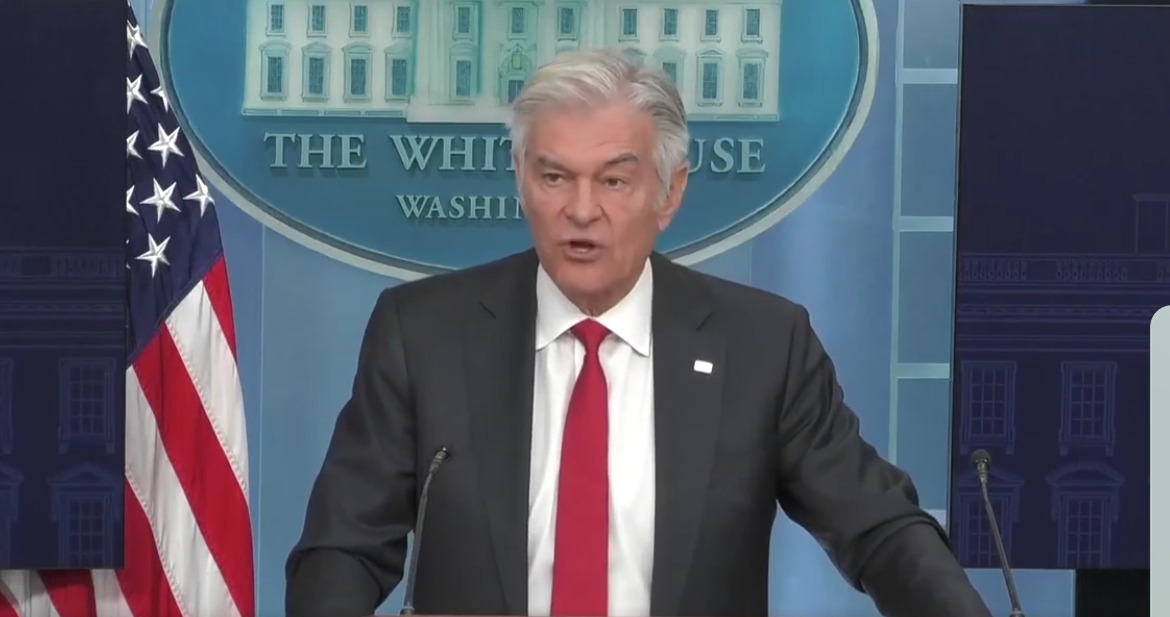
So it's so bad they gotta lie about it. I guess that's Mehmet Oz's job?
What the administration (and Dr. Oz specifically) are lying about (or at least vastly exaggerating) is the reason why so many people are losing their coverage this year.
He keeps blaming pretty much all of it on "fraud" and "improper enrollment," except that his basis for this is mostly a combination of highly questionable circumstantial "evidence" and changes to the rules on who's "eligible" to begin with.
There's really 3 categories:
- Actual fraud: There really was a problem with unscrupulous insurance brokers signing some people up without their knowledge or permission or even switching them from one carrier to another mid-year without their knowledge or permission, in order to get the commission.
This was mostly due to security flaws in the system which were cracked down on by the Biden administration in 2024 and more so by the Trump regime in 2025. While this was a real issue, it was brokers committing fraud, not the enrollees themselves, and again, it was mostly nipped in the bud well over a year ago.
- The "circumstantial" evidence Oz keeps throwing around mostly comes from the "Paragon Institute," a rightwing healthcare think tank run by a guy named Brian Blase. They've published a bunch of studies claiming to "prove" massive ACA enrollment fraud by citing things like a high percentage of ACA enrollees "never filing a claim" in a given year.
This is likely true, except that it's normal for a chunk of policyholders of any type of insurance to never file a claim in a given year. I've been paying homeowners and auto insurance for decades without ever doing so. That doesn't mean I'm committing fraud or that I don't exist.
In addition, the average ACA enrollee is only enrolled in a given policy for an average of eight months per year, meaning the odds of them not filing a claim are higher than if they were enrolled for all 12 months.
Finally, their methodology is sloppy: According to a trusted friend who's checked the study by the Paragon Institute, they were double-counting anyone who switched plans mid-year, which millions of enrollees do.
 John Stoehr
This means that if I was enrolled in, say, a Blue Cross plan from January to June here in Michigan, then moved to Wisconsin and switched to a Meridian plan for July to December, but never visited the doctor all year, my wife and I would be counted as four "phantom enrollees" – six, in fact, since our adult son would still be on our plan.
- Finally, there's the "improper" enrollees: These are people who Dr. Oz "thinks" shouldn't be eligible for subsidies, which includes, as an example, several hundred thousand low-income documented immigrants who have lived in the US for less than five years, making them ineligible for Medicaid.
Until this year, this category of immigrants were eligible for ACA subsidies if their income was below 100 percent of the federal poverty level (FPL). Last year the Trump regime made administrative changes – later codified as part of the Big Ugly Bill – which stated that that population is no longer eligible for financial assistance via the ACA. Result? Enrollment below 100 percent FPL plummeted by 45 percent year over year, from around 550,000 in 2025 to around 305,000 this year.
What do you think the next year will look like? Can the ACA survive?
Yes, mostly. Eight years ago Trump 1.0 attempted to repeal the ACA head on and came within a single nay of doing so.
This time they're basically slowly starving it to death.
Assuming no further devastation via another reconciliation bill, a year from now I'd expect ACA enrollment to have dropped to perhaps around 16 million (down around 6 million from last year's peak) and Medicaid expansion enrollment (the other half of the ACA's coverage gains) to have dropped by several million as well (it was around 20 million people as of a year ago).
The remaining subsidies (which are actually still less generous than they were even before they were upgraded by Democrats and Joe Biden in 2021, due to additional administrative tinkering by Trump 2.0) will at least act as a backstop to prevent enrollment from completely plummeting off a cliff
So instead of a "death spiral," it will be more along the lines of a de facto high-risk pool.
The 2027 rate filings are already starting to come in, and so far those are looking like perhaps 15-20 percent higher for unsubsidized enrollees on average, due in part to millions of healthier enrollees dropping coverage. That means the remaining enrollees are sicker and more expensive to treat on average, which in turn means higher premiums, and so on.
Again, normally this would lead to a full death spiral, but the remaining subsidies should prevent it from fully spiraling. Instead, you'll just have the sickest and most expensive people enrolled with massive subsidies to cover most of the ever-increasing premiums, but only if they earn between 100-400 percent FPL.
Those who earn over 400 percent FPL, who were already having a hell of a time affording full-price premiums before 2021, are already finding full price difficult or impossible to pay for now, and this will continue to get worse next year.
Those who earn less than 100 percent FPL and who live in one of the 10 remaining non-expansion states (except WI; that's a special case) will continue to find any legit healthcare coverage unaffordable.
As I said, this amounts to the equivalent of a high risk pool, but only for a subset of the population. Anyone below or above that income range who also has high medical expenses is (and will continue to be) pretty much screwed, unless their income is so high that they can afford to pay full price.