The taboo against naming Trump's dementia is fading
Normalized insanity won't last much longer.

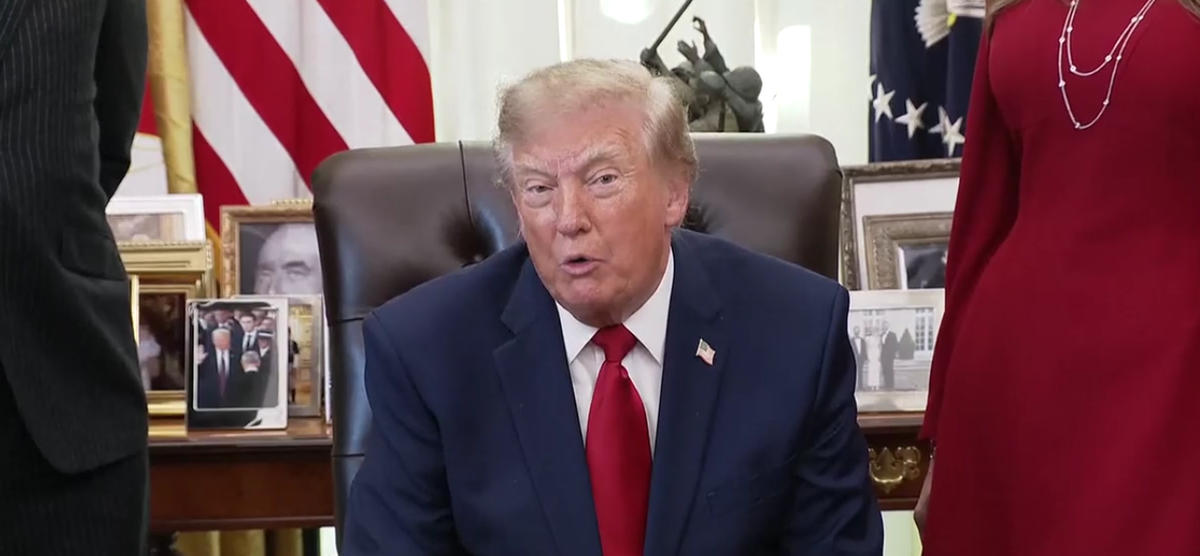
I think the president of the United States really believes "there's never been anybody" who deserves the Nobel Peace Prize more than he does. He really believes he "settled eight wars." He really believes he stopped "the total obliteration of the world" by going to war with Iran.
And I think he will try to punish anyone who does not share his beliefs. As president, Donald Trump has vast powers at his disposal. "I can do whatever I want," he told reporters on Wednesday. Evidently, that includes forcing people to believe his delusions of grandeur.
Yesterday, it was announced that Judge Navi Pillay had been awarded the prestigious award. She's a former jurist for the International Criminal Court in the Hague, the Netherlands. She presided over monumental cases involving genocide, war crimes, and crimes against humanity. When asked for comment, Pillay joked: "I may share this prize with Trump."
[Leave a tip in the tip jar! Say $10? THANKS!]
Within hours, the administration said it placed economic sanctions on the court, preventing US businesses from providing services. Secretary of State Marco Rubio said the ICC was "a rogue court." The sanctions will continue, he said, until "allies, many of whom are part of the ICC and that rely on American service members for their defense, rein in the court."
But after seeing a superpower brought low by Iran, US allies don't rely on "American service members" like they used to. More importantly, Trump's sanctions are an obvious attempt to compel belief in his fantasies. The Washington press corps has "normalized having an insane president," as Aaron Rupar said, but allies must see it clearly. They don't have the luxury.
That said, widespread crisis has a way of changing what's considered normal. Last month, I noted twin patterns. On the one hand, Trump's advisors have been getting "increasingly blunt" with him, according to the Post, about the jeopardy his party is in due to the Iran war. On the other hand, as the economic fallout from the war continues to build up, reporters seem to be getting "increasingly blunt" with voters as well as administration officials.
I didn't mean reporters are becoming adversarial. I meant they are becoming less inclined, as the backlash gains momentum, to play along with the White House line. CNN's Jake Tapper, for instance, has never met a rightwing allegation he was not willing to give credence to. Yet when confronted with wild distortions by Kevin Hassett, head of the Economic Council, Tapper said voter unhappiness is showing up in the data, "just not the data you're looking at."
Worse, for Hassett's credibility, was Tapper's side-eye!
Courtesy of CNN via Aaron Rupar.
Donald Trump is weakening politically. (A new poll from Pew, the gold standard of polling, showed his approval is 30 percent. Virginia's governor told MeidasTouch last night: "At this point in time in 2022, a little over 200,000 Virginians had voted. At this point in time in 2026, approximately 450,000 Virginians have voted early.) As he does so, there may be more incentive to focus on other weaknesses, including his mental deficits. Up to now, talk of cognitive decline has been on the margins, a subject debated among critics. The furthest forward it has come is in the form of regular rhetoric, as when Mike Barnicle memorably called Trump a "damaged, delusional old man," suggesting dementia without naming it.
But the weaker Trump gets politically, I think the less hesitance there will be in breaking the taboo that's currently preventing people from naming what they see. Last week, for instance, Time released the transcript of a long interview. For some, it revealed a broken brain. It raised the question as to whether Trump can tell the difference between fact and fiction.
"It’s almost unbelievable that this man is the president," Amy McGrath wrote on Twitter. "He rarely finishes a coherent thought. At one point, he actually says that all of his decisions 'are correct ones.' His explanations of the national debt and basic economics are astonishingly muddled. He makes false claim after false claim with absolute confidence. I can't tell if he just doesn't care that he's lying or actually believes the lies himself. Reading the transcript — not watching him, not hearing the delivery, just reading his actual words — is jarring."
I think the strongest evidence to suggest the dementia taboo is fading came from the Times' Katie Rogers. She has covered Trump rallies for a decade. Last week, she said they "feel like the first stops of a farewell tour." There's less attendance, so there's less coverage. "There were swaths of empty seats at the 10,000-capacity athletic center where Mr Trump spoke on Friday," she wrote. "In Ohio a day later, several areas of an upper deck were empty by the time Mr Trump finished speaking at a 4,500-capacity high school student activity center."
But at the top of her report was this: "The events are a ritual. He will attack Democrats. His words will probably stop making actual, logical sense for a moment, or for many moments. (It’s “the weave,” you see.) He will accuse Democrats of rigging the 2020 election (they didn’t). He will attack the news media. Then he will dance to a Village People song" (my italics).
With the dam heaving under pressure, critics are pushing harder. Lawrence O'Donnell might have gone farther than anyone so far. He said Thursday: "If the president of the United States is insane, that is the biggest news of the day or any day. That is what will live in history. That is what historians will devote their attention to if the president of the United States is insane. If the president of the United States’ mind is crumbling before our very eyes, that is the most important story of the day because everything else follows from that, everything!”
In good times, it's tempting to put his derangements in the context of familiar partisanship. A desire to be a dictator on day one of his second term? That's just Trump being Trump!
But bad times make things hit different. This week, he said, "I can do whatever I want," in the same breath as "I stopped the total obliteration of the world," as if he were a superhero. He punished the International Criminal Court for Navi Pillay's decision to poke fun at him. His fantasies hit different when he demands the world validate them or suffer the consequences.
The times, they are a-changing.
Normalized insanity won't last much longer.
That's all for today. Please consider subscribing! I know you like it. I know you'll love the price! For just $9 a month, you get so much, plus the satisfaction of supporting independent journalism. (Don't know if you're a subscriber? Check your status below.) –JS