The real reason Hakeem Jeffries cussed out Donald Trump
It’s not only because the president has "lost the culture."

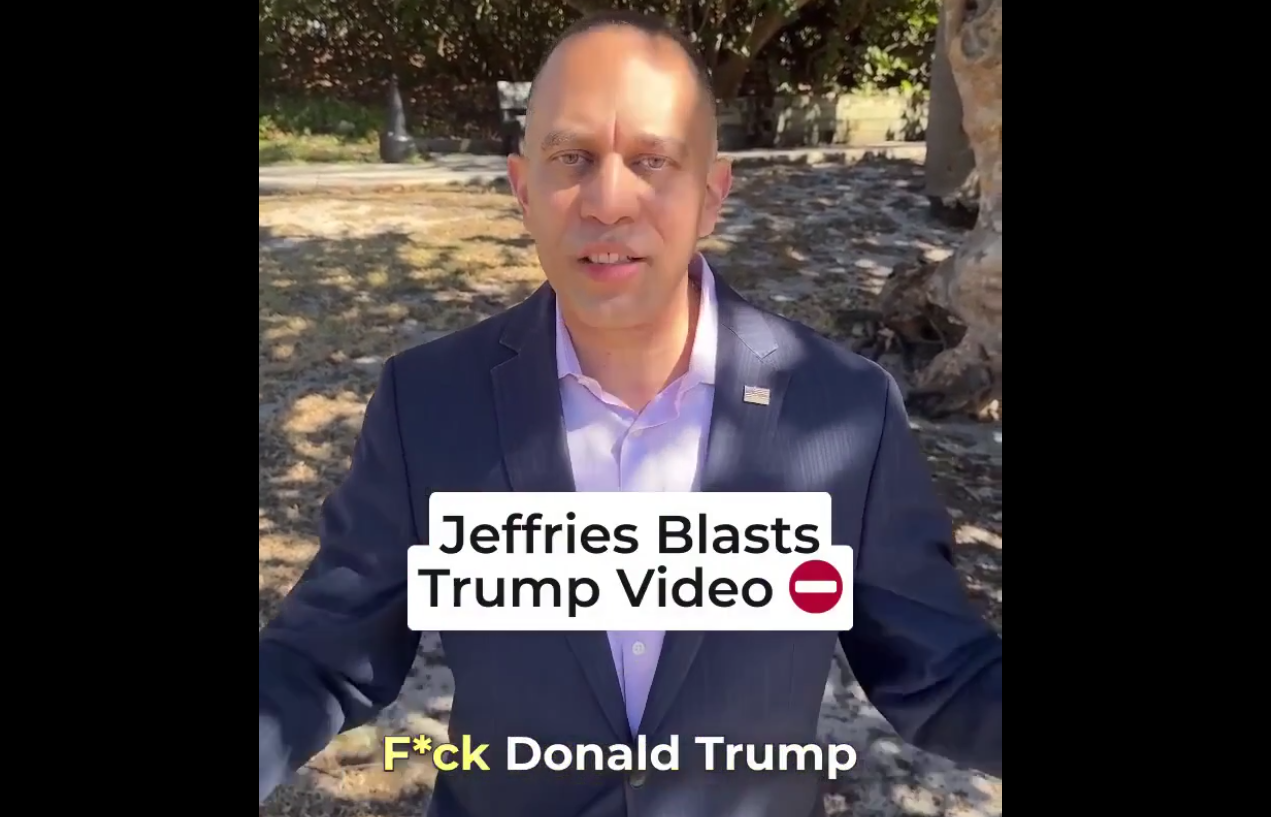
A lot of attention has been given to Hakeem Jeffries recently on account of him dropping the f-bomb. In reaction to the president reposting a video depicting Barack and Michelle Obama as apes, the House minority leader, in his own video, said “fuck Donald Trump.”
I think it’s worth asking why Jeffries did that beyond the usual explanations. The conventional wisdom is that Donald Trump’s video was so disgustingly racist that Jeffries was expressing an appropriate level of emotion in calling on GOP colleagues to condemn it.
But while emotion would explain the reaction of a normal person, Hakeem Jeffries is anything but normal. He’s a party leader in the United States Congress. As such, emotional reactions are typically taboo. For him to say “fuck Donald Trump,” something in the political landscape must have changed so that saying it is not only OK, but good for his party.
What has changed? Consider the following example of Trump’s behavior since ICE and Border Patrol killed two middle-class white people in Minneapolis. Referring to Alex Pretti and Renee Good in an interview, he said: “He was not an angel and she was not an angel.”
Courtesy of NBC.
When I heard the president say that, I immediately thought of that infamous Times article published in 2014 that reflected on a white police officer killing Michael Brown in Ferguson, Missouri. The Times reporter accepted as true propaganda provided by the Ferguson police department pushing the view that the 18 year old was somehow deserving of his death.
“[Brown] lived in a community that had rough patches, and he dabbled in drugs and alcohol,” the Times reporter said. “He had taken to rapping in recent months, producing lyrics that were by turns contemplative and vulgar. He got into at least one scuffle with a neighbor.”
In addition to Brown stealing a box of cigars and pushing a convenience store clerk, the above details were enough for the Times reporter to conclude that he “was no angel.”
What was done to Michael Brown and countless others was done in accordance with what you might call the rules of white power – the law should protect inpeople (in this case, a white cop) and punish outpeople (in this case, a Black man). That he did nothing to deserve death by the state is incidental to enforcing the rules of white power. Michael Brown was already seen as guilty. Smearing him was merely an effort to prove “the truth” after the fact.
After Renee Good and Alex Pretti were killed, they were smeared the same way Michael Brown was, all in an effort by the regime to justify their deaths by the state. The difference, obviously, is that they weren't outpeople. Anti-Black racism wasn't supposed to be directed at them. Donald Trump may be the epitome of white power, but he’s breaking the rules.
And white people don’t like it.
Courtesy of Oliver Willis.
According to a poll released February 4, Trump’s job approval rating dropped 11 points in the month since Good's death. Just 41 percent approve, with 57 percent disapproving (an increase of 12 points). This poll is important to note because it’s Rasmussen's. The most Trump-friendly poll on the market, Rasmussen tends to reflect the views of America’s white majority. Forty-one percent in Rasmussen is like 31 percent in a more mainstream poll.
That white people don’t like Trump breaking the rules of white power can also be seen in polls about immigration. A new one by NBC News shows "a double-digit shift" in that "49 percent of adults strongly disapprove of how Trump has handled border security and immigration, up from 38 percent strong disapproval last summer and 34 percent in April.”
NBC’s poll found that "the administration’s aggressive tactics and deportation goals have dragged down Americans’ views of Trump on the very issue that helped sweep him into office." That's a very oblique way of putting it. A more direct way is that those “aggressive tactics” weren’t supposed to break the rules of white power. Now that they have, “self-identified independents” – what I call respectable white people – are driving “the erosion, with the share of strong disapprovers in that group having risen 11 points since August.”
I think implicit in all this polling is a concern that white people have rarely if ever felt before – whether their own police departments will shield them from the same violence that killed Renee Good and Alex Pretti. Occasionally, a viral video will show state and local cops doing what’s expected of them, but those seem to be overwhelmed by the number of videos showing state and local cops appearing to take the side of the regime.
Friends in Minneapolis are very worried about this development. Both in terms of state police's role in arresting protestors and the worry that this could set off the kind of spiral of distrust and destruction that followed George Floyd's murder. www.nytimes.com/2026/02/07/u...
— Clara Jeffery (@clarajeffery.bsky.social) 2026-02-08T18:26:54.764Z
Compounding matters is a largely unknown effort by the Trump regime to co-opt state and local law enforcement. Called “Task Force Model,” the program pays salaries and benefits to state and local cops who aid ICE and Border Patrol. During an appearance on MS Now, Matt Lewis said the arrangement could be detrimental to the midterms. His larger point, however, is “the person who pays you becomes your boss.”
It is an article of faith among respectable white people (the term I prefer) that state and local police departments are there to serve and protect everyone. This faith is rarely shaken, even when white cops kill Black men. Indeed, such moments usually serve to deepen that faith.
The only way imaginable to undermine that trust would be if the institutions of law enforcement started treating respectable white people the same way they have historically treated everyone else – in other words, if inpeople no longer received the unconditional deference and protection of the law and were punished the way outpeople have been.
I wouldn’t say that faith has been shaken, but Trump is creating potential for it by wedging two camps no one imagined could be wedged. And in doing so, I think he risks white power backfiring on him. Not because respectable white people are going to suddenly become anti-racists, but because they are unlikely to tolerate being treated like Black people.
Courtesy of CPSAN.
That’s what’s changed. That’s why someone like Hakeem Jeffries, a Democratic leader whose job depends on his skill in finding the middle of the middle of the road, a man who was until last month focused on affordability and nothing else, suddenly has the confidence to cuss out Donald Trump. He believes he’s speaking with the blessing of a new majority.
He probably is, but don’t be fooled as to why. It’s not because Trump has “lost the culture.” It’s not because he has “lost the country.” Those are euphemisms to paper over a backlash by respectable white people against a president whose authoritarian impulses did not stop at the color line, as they were supposed to, according to the rules of white power.
Lots of white people are, at best, indifferent to anti-Black politics. They want to be seen as “above politics,” because that’s what makes them seem “respectable.” However, that indifference melts into the air when anti-Black politics is directed at them. The shock of being the target of corruption and injustice is enough to turn them into revolutionaries.
Footnote
If you squint your eyes and tilt your head a bit, you can see how much of today's argument came out of a recent conversation with my friend, Stephen Robinson.
I'm terrible at video. I'm just a mess. But if you have the time and patience, you can see all the threads originated there. Today's edition tried to weave them together.
Here's my conversation with Stephen. Please do check out his podcast and newsletter, and consider supporting his work with a subscription. You won't regret it.