How many times does Trump have to be accused of rape for it to matter in this country?
A new report by the House Judiciary Democrats is one step toward change.

I am going to tell you why I think the Democrats on the House Judiciary Committee released on Monday a 53-page report presenting new evidence of Donald Trump’s involvement in Jeffrey Epstein’s sex-crime syndicate, efforts by the Department of Justice to cover it up, and the Democrats' call for a special counsel. But before I do, let me quote the report directly.
Above all, the actual evidence we have seen — as shared in the accounts and stories of 11 women, each described below — indicates that Trump abused, assaulted, and even raped numerous women alongside, and in coordination with, the most infamous sex trafficker in history.
These stories are united by time, place, and the distinct factual similarities in how Trump and Epstein pursued, manipulated, and abused these women. With one exception, these accounts of sexual assault and conspiracy involve episodes that took place between 1992 and 1997 in New York City and Palm Beach, at a time when Trump and Epstein were ‘close friends’ and participated in a shadowy subculture organized around young female modeling.
Witnesses speak consistently of modeling pageants and parties where young women and girls were forced into predatory situations and routinely taken advantage of, abused, and raped. They give similar accounts of the competitive and sinister relationship between Epstein and Trump and how it was channeled into their shared pursuit of young women.
Taken together, the evidence provided by the stories of these 11 women, and the documentary evidence that supports and corroborates their stories, indisputably meets and surpasses FBI’s standard for opening a full investigation: that “activity constituting a federal crime … may have occurred.
Julie K Brown, the Miami Herald reporter who knows more than anyone about all things Epstein, said yesterday that much of the material in the report comes from public records and documents released after passage late last year of the Epstein Files Transparency Act.
Brown said what’s new is an allegation from a former beauty contestant from Switzerland by the name of Beatrice Keul. She told the committee that Jeffrey Epstein arranged a meeting with Trump at the time one of his pageants. She said he raped her in 1993 in New York.
Here's the key part of the report:
Later that day, Donald Trump’s representative invited Keul to go upstairs at the Plaza Hotel to meet with Trump. Believing this meeting to be a lucky break for the purpose of furthering her career and education, Keul accompanied Trump’s representative upstairs. He ushered her into the suite, where upon entering, Trump reportedly grabbed Keul from behind and forcibly raped her; in the process, tearing her dress and causing bleeding and bruising on multiple parts of her body. Keul described the rape as ‘brutal.’ Following the assault, according to Keul’s report, Trump sat her on the edge of the bed, repeated his promises to arrange for a visa and NYU admission, and made her promise she would keep quiet, saying, “[T]he show must go on.”
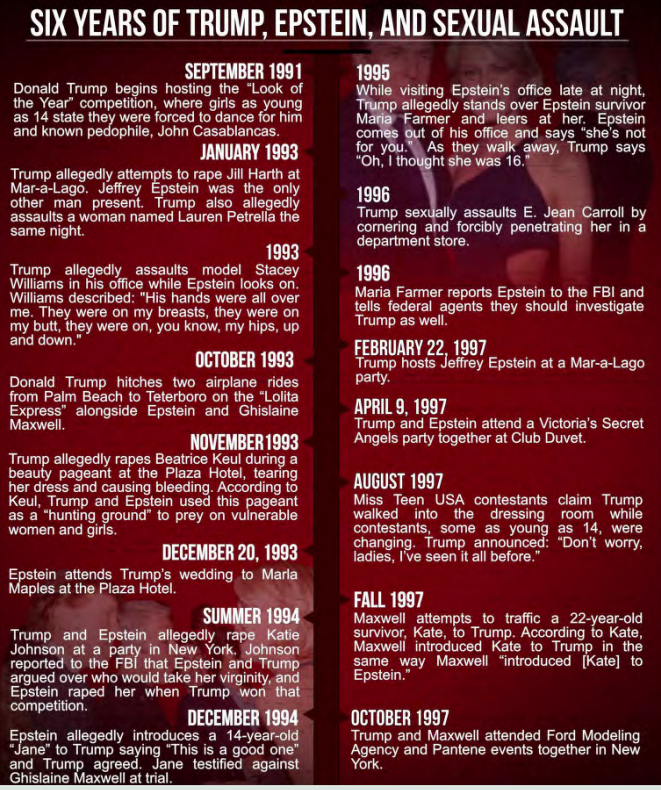
The report said Keul is one of five women to directly accuse the president of "raping or sexually assaulting them in Epstein’s company or direct physical presence":
• Beatrice Keul, whose account is comprehensively set forth for the first time in this report, credibly alleges that Trump violently raped her at a November 1993 pageant at the Plaza Hotel in New York City and that Epstein, Trump, and others used this pageant as a “hunting ground” to prey on vulnerable young women and girls;
• Stacey Williams, who offered a detailed and corroborated account of Trump sexually assaulting her in the early 1990s while she was alone with him and Epstein in an office at Trump Tower;
• Jill Harth, who has also publicly detailed Trump aggressively pursuing and violently sexually assaulting her and another woman in 1994 at a Mar-a-Lago party where Epstein and Trump were the only men present;
• Katie Johnson, who gave FBI a detailed account of her repeated rape at the hands of Trump and Epstein in 1994 in New York City when she was a minor; and
• A Jane Doe, who offered FBI a graphic account of Trump assaulting her when she was a minor in the mid-1980s in New York by forcibly pushing her head down to his exposed penis.
That's the what. As to why the Judiciary Democrats released the report, the reason isn't what you think. It isn't because there's a midterm next week. It's no October Surprise. Hardly any major media paid attention to it. It is not going to change the election's fundamentals.
It is, however, a kind of preview. This is what we can expect from a House controlled by the Democrats in the two years leading up to the next presidential election. Impeachment is still a question, but there is no downside to subjecting Trump to endless grinding exposure. The weaker he gets politically, the more cracks there will be in his coalition. If you think he's unpopular now, wait until Robert Garcia, the Judiciary's ranking Democrat, gets going.
But I don't want to get lost in the politics. These are real people. These are real crimes against them. They should see justice. More broadly, we cannot hope for our republic to survive if men like Trump, who act with impunity for the law and morality, are allowed to carry on without fear of accountability. Trump will probably never see a jail cell (he's 80, after all) but he is not alone. Many elites enabled him along the way, because they thought something was in it for them. There must be a price for impunity, and someone must pay it.
This report isn't going to affect the election. It's not going to bring justice. And it's certainly not going to restore law and order. But I hope it's the first of many steps toward that end.
Pastor Dan's 14 points on El-Sayed's remarks on religious freedom
Abdul El-Sayed was confronted recently by a man known as Tommy. Tommy wanted Michigan's Democratic Senate candidate to disavow Egypt's Muslim Brotherhood. The implicit allegation is AES is in cahoots with the terrorist organization, because he's Muslim and his lineage is Egyptian, and if he does not disavow them, then he's one of them.
In the video below, you can see AES turn Tommy's religious bigotry into an opportunity to remind everyone of the meaning of the First Amendment. He deftly turns things around so that he, the Muslim, is the defender of religious freedom while Tommy, the self-identified Christian, would rather codify his faith into law. Takeaway: Who's the real radical here?
The video went viral and provoked a flurry of online commentary. One of the best commentaries was Reverend Dan Schultz's. He's a Wisconsin pastor, contributor to the Editorial Board, and my pal. His 14 points are reproduced here with his kind permission.
Courtesy of the Abdul El-Sayed campaign.
- El-Sayed was definitely prepared for that kind of question from that kind of questioner, but he also was able to take advantage of a couple of big holes in GOP strategy, such as it is.
- The premise of Tommy's attempt at a gotcha question was based in Christian nationalism, sure, but even more so in Christian normalism, ie, the assumption that "normal" voters are Christians.
- The "nationalism" part comes in the further assumption that normal Christians reject Islam as antithetical to their faith, and want conservative Christian values written into governance.
- There's more, too: the question seems designed to tap into fears about Michigan's rapidly-growing Arab population, and tap into out-state resentment of the Detroit metro area.
- I don't think Tommy thought he was going to turn the room against El-Sayed. More likely, he was trying to get El-Sayed to commit some gaffe that could be shared on social media — but there's a reason people like Tommy pull these stunts in towns like Caro, not Dearborn.
- What Tommy may not have known is that many of Michigan's Arabs are in fact Christians, maybe up to half of them. So it's hard to other them on that score.
- And while this crowd seemed to be mostly El-Sayed supporters, it doesn't seem like anyone was too inclined to othering, on the basis of religion, or race, or geography. I heard some pretty loud cheering for El-Sayed's repeated "or no faith."
- The conservative base seems to have convinced themselves that most voters share their biases and preferences. That might have worked in 1980s Michigan, and in 2024 Michigan, voters might have ignored the nationalism in hopes of getting a better economy.
- But in 2026, Republicans have failed so dismally on the economy and, well, any other kind of governance that it's easy for voters to see that all they've got is the white Christian nationalism.
- That gives someone like El-Sayed the opening to speak and react confidently. He knows Tommy's coming at him with a bluff and a weak hand. The only people who care about him rejecting the Muslim Brotherhood aren't going to vote for him anyway, so he doesn't have to dodge or weave. He can just attack.
- And attack he does, brilliantly. I thought the bit about the Constitution was great, not because it's a secular counterweight to Christian chauvinism, but because El-Sayed framed it perfectly as a neutral operating system that Americans buy into as the rules of the game.
- That's the real weight of his counterpunch: not that Tommy is a bigot (though he kind of is), but that Tommy won't agree to play by the same set of rules he demands El-Sayed play by. Who's the outlier here?
- Anyway, none of this is brilliant or original insight. It's just helpful in understanding the corner Republicans have painted themselves into, in Michigan and nationally. They have fundamentally misunderstood the electorate, and it may cost them for a really long time to come.
- To be pithy about it, if you're going to run the "divide and conquer" flim-flam, you have to convince the marks there's something in it for them. The GOP can't do that, which leaves the opening for somebody like El-Sayed to expose the con for what it is.